


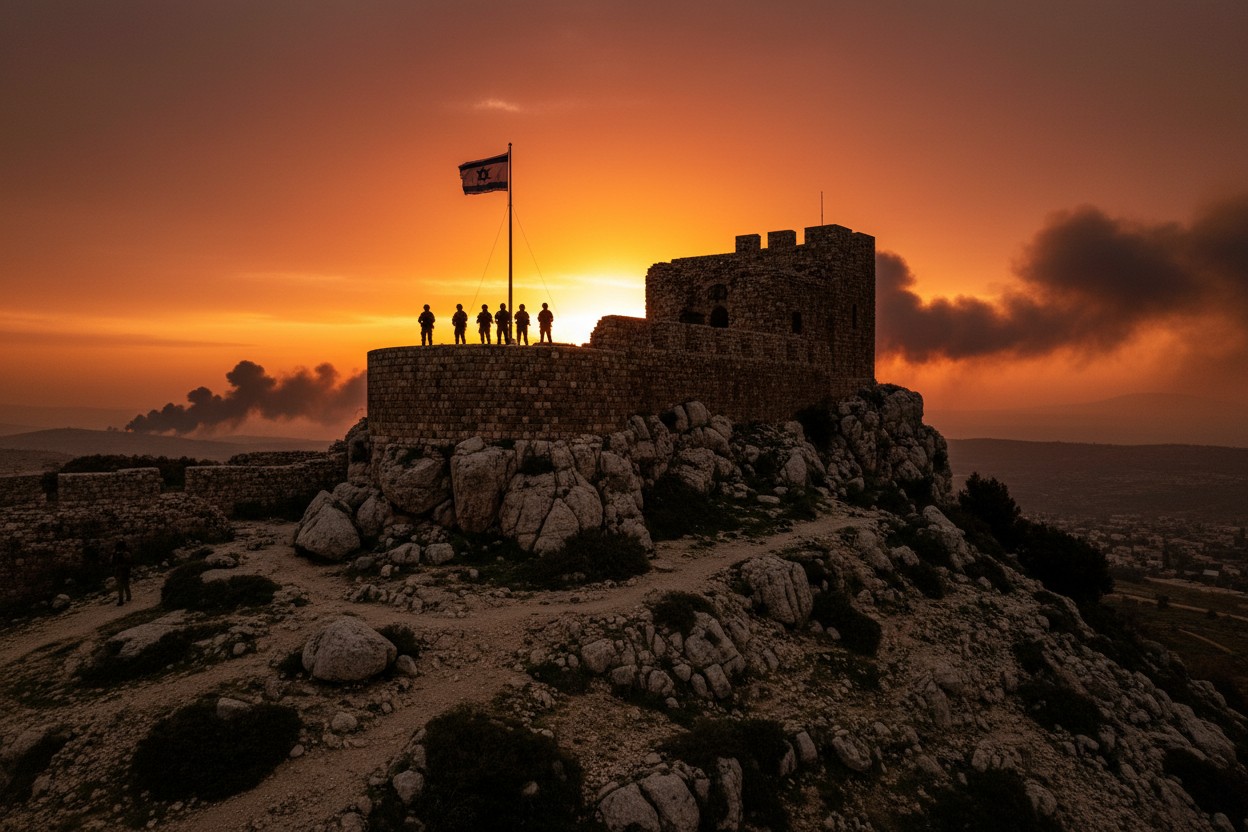
Israel Captures Medieval Beaufort Castle in Southern Lebanon Amid Ongoing Operations
Israeli forces captured the 900-year-old Beaufort Castle and the strategic ridge surrounding it in southern Lebanon on May 31, 2026, according to military statements. Prime Minister Benjamin Netanyahu announced the move and ordered the military to expand its ground maneuver in Lebanon, officials said. The medieval castle, also known as Qalaat al-Chakif, was previously used by Israel as a base during its two-decade occupation of southern Lebanon that ended in 2000, according to reports from multiple outlets [1][2][3].
The capture of the fortress and ridge deepens Israel’s footprint beyond the demarcation zone known as the “Yellow Line,” which it established in April following a ceasefire, according to Middle East Eye [1]. The operation marks the deepest Israeli push into Lebanese territory in nearly three decades, according to Zero Hedge [2].
Details of the Capture and Strategic Significance
The Israeli military confirmed that no weaponry was found inside the castle, according to media reports carried by RT [3]. Prime Minister Netanyahu described the capture as a “dramatic stage” and a “dramatic shift in the policy we are leading,” according to a video statement quoted by Middle East Eye [4]. “Today, we have returned to Beaufort in a different way. We have returned united, determined, and stronger than ever,” Netanyahu said [4].
The Israeli Broadcasting Corporation aired images showing the Israeli flag and the banner of the Golani Brigade flying above Beaufort Castle, as reported by Middle East Eye [5]. The IDF released footage of its troops in the area, stating, “Our forces have crossed the Litani [River] and expanded their attacks against Hezbollah operatives and infrastructure” [5]. Historically, the castle has been a key strategic objective: during the 1982 invasion, according to a biography of Menachem Begin, “By next morning the Star of David was flying over Beaufort Castle, a Crusader fortress high above the Litani gorge” [6]. Avigdor Kahalani, in his memoir “A Warrior’s Way,” describes training a special force to capture the “terrorist stronghold at Beaufort Castle” [7].
Continued Bombing and Ceasefire Status
Israel intensified airstrikes around the city of Nabatieh, which is expected to be the next target in the ground offensive, according to RT [3]. Footage from the area showed large plumes of smoke and dust from airstrikes, with heavy damage to residential areas and surroundings, the report stated [3]. Middle East Eye reported that Israel committed several massacres with strikes on south Lebanon as troops advanced toward Beaufort Castle [8], and the military issued sweeping expulsion orders for residents south of the Zahrani River [9][10].
The ongoing hostilities continue despite a ceasefire declared on April 17, according to multiple reports [3]. The truce never halted combat operations, with both Israel and Hezbollah repeatedly accusing each other of violations, according to RT [3]. Hezbollah deepened its rocket strikes in response to what it described as Israeli escalation, according to The Cradle [8].
Broader Regional Conflict and Negotiations
The conflict in Lebanon is a spillover from the US-Israeli attack on Iran, according to analysts cited by RT [3]. Iran has made a comprehensive end to the war in Lebanon a condition in its Pakistan-mediated negotiations with Washington, which have been ongoing since early April but have not produced tangible results, according to the same report [3]. The Times of Israel noted that Iran proposed a deal with the United States to reopen the Strait of Hormuz and end the war while delaying nuclear talks, with the offer conveyed via Pakistani mediators [11].
France requested an emergency meeting of the UN Security Council on Monday to discuss Israel’s expanding occupation in Lebanon, according to diplomatic sources cited by AFP and reported by Middle East Eye [12][13]. A senior Israeli diplomat mocked Paris for calling the meeting, pointing to France’s domestic troubles, according to RT [14].
Conclusion
The capture of Beaufort Castle marks a significant military development in a conflict that continues despite diplomatic efforts. Further ground operations and airstrikes are expected as Israel deepens its hold in southern Lebanon, officials said. The Israeli prime minister stated his directive is “to deepen and expand our hold in places that were under Hezbollah’s control” [4]. With negotiations between Iran and the United States showing no progress, the regional situation remains tense and hostilities are likely to continue, according to available reports [3][11].
References
- Middle East Eye. “Israel seizes strategic castle as it expands invasion of south Lebanon”. May 31, 2026.
- Zero Hedge. “Israel Seizes Crusader Beaufort Castle, Marking Deepest Plunge Into Lebanon In Decades”. May 31, 2026.
- RT. “Israel moves deeper into Lebanon, captures medieval castle (VIDEOS)”. May 31, 2026.
- Middle East Eye. “Netanyahu describes Israeli seizure of Lebanon castle as ‘shift in policy'”. May 31, 2026.
- Middle East Eye. “Israel broadcasts images of forces at Beaufort Castle after capture claim”. May 31, 2026.
- Eric Silver. “Begin: A Biography”. 1984.
- Avigdor Kahalani. “A Warrior’s Way”. S.P.I. Books. 1994.
- The Cradle. “Hezbollah deepens rocket strikes in response to brutal Israeli escalation”. May 31, 2026.
- Middle East Eye. “Israel seizes strategic castle as it pounds southern city of Sour”. May 31, 2026.
- BBC News. “Israel seizes castle in Lebanon as it expands ground offensive”. May 31, 2026.
- Times of Israel. “Iran said to offer US deal to reopen Hormuz and end war, delay talks on nuclear program”. April 27, 2026.
- Middle East Eye. “UN Security Council to hold emergency meeting on Lebanon”. May 31, 2026.
- Middle East Eye. “France requests UN Security Council emergency meeting on Lebanon”. May 31, 2026.
- RT. “Senior Israeli diplomat mocks France for calling UNSC meeting on Lebanon”. May 31, 2026.
Explainer Infographic
Read full article here