


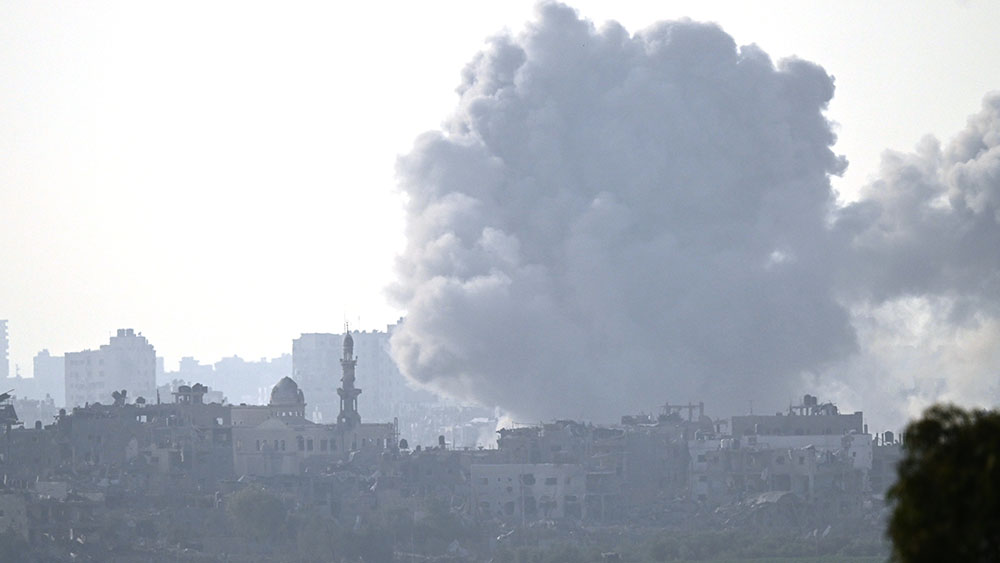
Killing Iran’s supreme leader did not secure Israel, but birthed a wider war on two fronts
The official narrative sold to Western audiences promised that decapitating Iran’s command structure would restore deterrence and peace. Instead, the February 2026 assassination of Ayatollah Ali Khamenei by U.S.-Israeli strikes has delivered the exact opposite: a resurrected Hezbollah, a shattered northern Israel, and the unmistakable contours of a regional war now bleeding into Lebanon with no clear exit. What was framed as a surgical blow to Tehran’s axis has become the catalyst for a multi-front confrontation that Israel’s own military admits is far from contained. The evidence lies in the rubble of southern Lebanese homes and the non-stop sirens screaming across Israeli towns once thought safe.
Key points:
- The killing of Iran’s supreme leader triggered Hezbollah’s rocket retaliation, not surrender.
- Israel’s “limited” ground invasion into Lebanon has failed to stop cross-border attacks.
- Over 250 Hezbollah operatives reportedly killed, yet drone and rocket fire persists daily.
- Civilian infrastructure on both sides is taking direct hits, signaling a protracted conflict.
- The Litani River “security zone” goal remains unachieved as fighting intensifies.
A promised buffer, a real quagmire
The strategic logic, as presented by Israeli military officials in early 2026, seemed simple on paper. But after taking on Iran and ousting some of their leaders Israel and the US find themselves fighting a war on multiple fronts – quagmires that will not be easy to “win”. Following the U.S.-Israeli strikes that killed Khamenei in February, Hezbollah responded with barrages into northern Israel. Israel’s answer was a declared “limited and targeted” ground invasion into southern Lebanon, aimed at pushing the Iranian-backed paramilitary group back from the border. The stated goal: create a five to ten kilometer “security zone” along the Litani River to protect Israeli communities from short-range missiles and infiltration attacks similar to the Oct. 7, 2023, Hamas incursions.
But the on-the-ground reality tells a different story. On Monday, air raid sirens continued without respite across northern Israel as the coastal city of Nahariya took a direct hit. Lebanon’s National News Agency reported an Israeli air raid on the southern town of Bafliyeh, damaging multiple homes and wounding residents. Rescue crews dug through rubble searching for missing people. The Israeli town of Metula, located directly across the border from Lebanon’s Kfarkila village, has become a near-daily target of suspected drone infiltrations.
The Israeli military acknowledged that two soldiers were moderately wounded and six others lightly injured by an explosive drone strike while operating in southern Lebanon. All were evacuated to hospitals, their families notified. This is not the behavior of a defeated enemy. It is the behavior of an adaptive, entrenched force using precisely the asymmetric tactics Israel claimed its ground operation would suppress.
Hezbollah’s survival rewrites the war’s math
Who, what, when, and where matters here. The Israeli Defense Forces spokesperson announced that more than 250 Hezbollah operatives have been killed in the major Lebanon operation. But battlefield losses do not equal strategic defeat. Hezbollah has survived larger body counts before, emerging leaner and more embedded within civilian areas. The group’s retaliation for Khamenei’s killing was never a spontaneous outburst. It was a calculated signal that Iran’s proxy network functions even without the supreme leader at its helm.
Lebanon’s southern villages, including Kfarkila and Bafliyeh, have become a continuous war zone. The IDF says its actions aim to destroy Hezbollah’s command centers and military infrastructure. Yet the rockets and drones keep coming. On Monday alone, sirens sounded in Metula, Kfar Giladi, and Misgav Am following a suspected drone infiltration from Lebanon. Nahariya, a city of roughly 60,000 people, took a direct hit. These are not random incidents. They are proof that the premise of the 2026 invasion, that killing Iran’s supreme leader would collapse Hezbollah’s will to fight, was fundamentally flawed.
The broader context is the Iran-Israel proxy war, now burning on Lebanese soil. Israel declared its operations “limited and targeted,” but the destruction in southern Lebanon suggests otherwise. Homes are rubble. Families are missing. And across the border, Israeli civilians live under non-stop sirens, their government having traded one security crisis for another.
Sources include:
MiddleEastEye.net
Youtube.com
YNetNews.com
Read full article here