


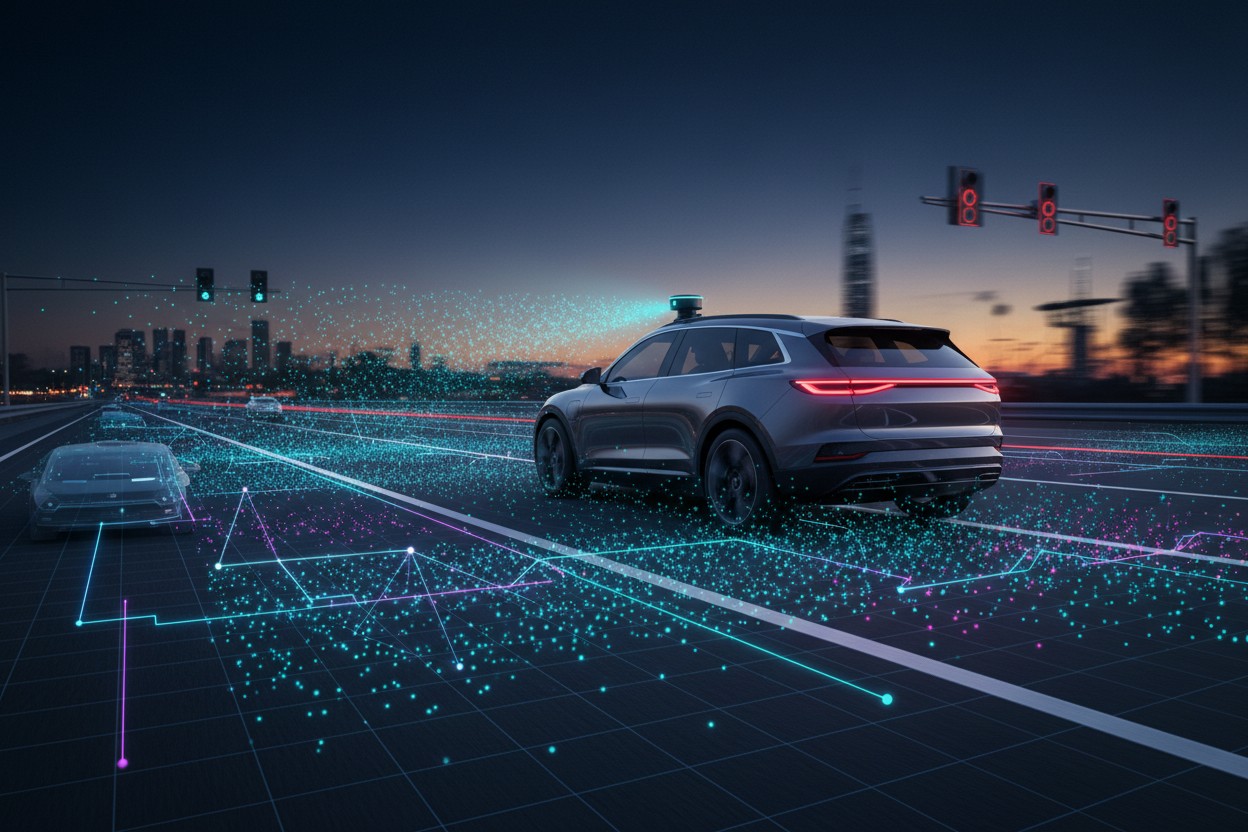
NVIDIA has integrated Apollo high-performance lidar into its DRIVE platform for autonomous vehicles, according to an announcement from the two companies. The integration is intended to give automakers and autonomous vehicle developers an additional sensor option for real-time perception and collision avoidance, officials said.
No pricing, ship date, or vehicle deployment details were included in the initial statement. The addition expands the range of sensor suppliers able to connect to NVIDIA’s DRIVE hardware and software stack, according to company statements.
NVIDIA DRIVE and Apollo Lidar
The DRIVE platform is NVIDIA’s computing system for automated driving. It includes system-on-chip hardware, AI software, and sensor-processing tools, according to NVIDIA. DRIVE Hyperion is a production-ready autonomous vehicle computing architecture, and DRIVE AGX Thor is among the centralized computers used in the platform, according to reports [1][2].
Apollo is the lidar product line of AEye, Inc. (Nasdaq: LIDR), a developer of lidar sensors and perception software, according to SelfDrive News [3]. The Apollo sensor is described as a high-performance lidar for object detection and classification. According to the same report, the sensor won the “Smart Sensing Technology Innovation Award” at the EAC 2026 Zhiyao Awards in Shanghai [3].
Within the DRIVE ecosystem, Apollo joins other lidar suppliers that have qualified sensors for NVIDIA’s open sensor ecosystem. Ouster’s Rev8 OS lidar family, for example, is qualified to run on the NVIDIA DRIVE Hyperion platform with software compatibility through the NVIDIA DriveWorks SDK, according to SelfDrive News [4]. NVIDIA’s sensor-processing approach also aligns with open standards such as OpenVX, which is used for performance-optimized computer vision in advanced driver-assistance systems, according to the book Embedded Vision: An Introduction [5].
Technical Details and Performance
According to SelfDrive News, the Apollo lidar sensor is capable of detecting objects at distances up to one kilometer [3]. The sensor is intended for use cases including advanced driver-assistance systems, autonomous driving, and broader physical AI applications, the report stated [3].
Autonomous vehicle perception typically combines lidar with camera and radar inputs. Radar transmits an electronic signal that bounces off objects and returns to the receiver, according to Embedded Vision: An Introduction [6]. Pre-trained neural networks are used in self-driving systems to detect pedestrians, vehicles, and traffic lights, including their color, according to Hands-On Vision and Behavior for Self-Driving Cars [7].
NVIDIA’s DRIVE software stack includes operating system and autonomous vehicle software engineered for Level 4 capability, according to SelfDrive News [8]. The DRIVE AV software is used to process sensor data for L4 autonomy, and the DRIVE AGX Thor computer delivers compute for such workloads, according to Robotics and Automation News [2]. Specific Apollo sensor specifications, including resolution and field of view, were not fully detailed in the announcement.
Industry Context
The announcement comes as lidar use in automated vehicles has expanded. Deutsche Bank analysts said 2026 was shaping up as a major inflection point for autonomous driving following the CES technology conference in Las Vegas [9].
NVIDIA has positioned DRIVE as an open platform that supports multiple sensor brands and partner computing approaches. In 2025, NVIDIA announced a collaboration with Toyota to develop next-generation autonomous vehicles using its Thor AGX processor, according to NaturalNews [10]. NVIDIA also announced a partnership with Uber to scale a Level 4-ready mobility network built on DRIVE AGX Hyperion 10 [11]. “Robotaxis mark the beginning of a global transformation in mobility — making transportation safer, cleaner, and more efficient,” said Jensen Huang, founder and CEO of NVIDIA [11].
The Uber partnership is intended to support scaling of its global autonomous fleet to 100,000 vehicles over time, starting in 2027, according to an earlier report [12]. The Apollo integration follows that open-platform approach, according to the companies. No customers using the integrated Apollo and DRIVE platform were named in the initial release.
Conclusion
The NVIDIA DRIVE platform’s addition of Apollo lidar gives autonomous vehicle developers another sensor-compute option, according to the announcement. The integration adds a lidar supplier with a sensor range of up to one kilometer to NVIDIA’s open sensor ecosystem.
Financial terms and production timelines were not disclosed. NVIDIA and AEye said more information would be provided as the platform becomes available to partners.
References
- SelfDrive News. “TIER IV and Isuzu Deploy Level 4 Autonomous Buses”. March 18, 2026.
- Robotics and Automation News. “Kodiak AI scales autonomous driving with Nvidia Drive Hyperion platform”. March 16, 2026.
- SelfDrive News. “Apollo Lidar Wins Smart Sensing Innovation Award in Shanghai”. May 28, 2026.
- SelfDrive News. “Ouster Qualifies Rev8 Native Color Lidar for NVIDIA DRIVE Hyperion Platform”. May 12, 2026.
- S R Vijayalakshmi and S Muruganand. “Embedded Vision: An Introduction”. Mercury Learning and Information. 2020.
- S R Vijayalakshmi and S Muruganand. “Embedded Vision: An Introduction”. Mercury Learning and Information. 2020.
- “Hands-On Vision and Behavior for Self-Driving Cars”. Packt Publishing.
- SelfDrive News. “NVIDIA, Uber, Stellantis Partner on Global AV Rollout”. October 29, 2025.
- Zero Hedge. “2026 Will Be Breakout Year For Autonomous Driving And Humanoid Robots; Deutsche Bank”. January 13, 2026.
- Arsenio Toledo. “Nvidia Announces Partnership with Toyota to Develop Autonomous Vehicle Tech”. NaturalNews.com. January 9, 2025.
- The Robot Report. “NVIDIA partners with Uber to deploy AVs starting in 2027”. October 28, 2025.
- Kevin Hughes. “NVIDIA and Uber Forge Historic Partnership to Deploy 100,000 AI-Powered RoboTaxis by 2027”. NaturalNews.com. November 2, 2025.
Explainer Infographic
Read full article here