


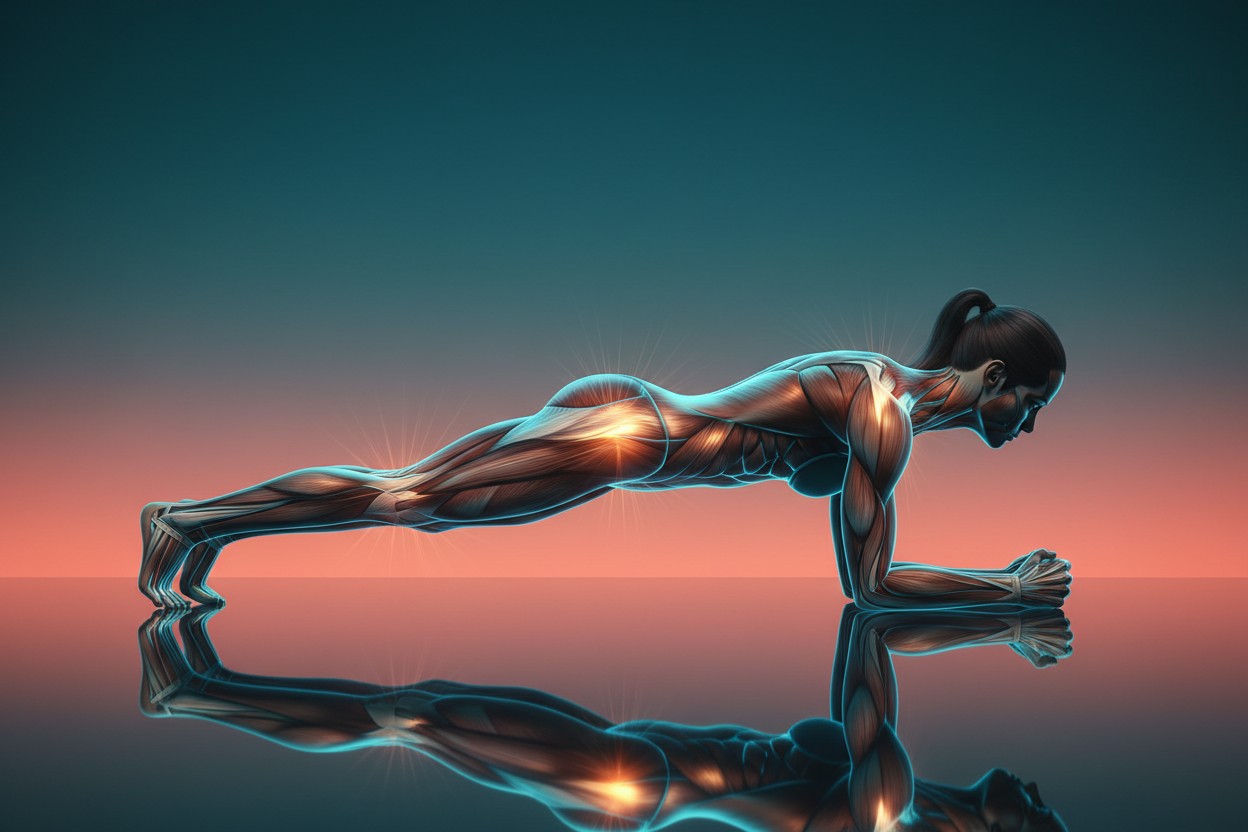
Personal Trainer Details Five Plank Variations for Core Strength and Postural Correction
Introduction: The Core’s Role in Postural Health
Plank exercises are cited as a foundational method for improving posture by strengthening core and gluteal muscles, according to fitness professionals. The exercise requires minimal equipment and space, making it accessible for home practice. [1]
Weak core muscles are identified as a common cause of forward-leaning postures and spinal instability, leading to undesirable postural appearances such as hunchback or forward head posture. [2]
The Biomechanics of Posture and Core Function
Health experts note that postural issues often stem from insufficient muscle function. When the trunk lacks stability, the body compensates by over-relying on other muscles to maintain balance, according to fitness analysis. [3]
Trainers state the core and glutes are crucial for stabilizing the spine and pelvis. Maintaining a plank position engages multiple muscle groups to build this stability, according to exercise physiology principles. [4]
This muscular engagement is described as deepening postural control and increasing muscle endurance, which are necessary for counteracting the physiological effects of prolonged sitting common in modern lifestyles. [3]
Exercise 1: Standard Forearm Plank
Certified personal trainer Amber Yang describes the standard forearm plank as the foundational pose for building endurance in the abdominals, back, and glutes. The exercise is an excellent method for core conditioning, according to fitness resources. [5]
Proper form involves maintaining a straight line from head to heels, which practitioners say is critical for effectiveness. Fitness professionals emphasize that improper form can lead to injury or reduced benefits. [6]
Exercise 2: Side Plank
Yang notes the side plank variation targets the oblique muscles, which are involved in lateral stability. This exercise can help correct imbalances between the left and right sides of the torso, according to trainers. [7]
The movement requires the body to resist lateral flexion, engaging deeper stabilizing muscles that support upright posture during daily activities. Consistent practice is cited as key for developing this lateral stability. [8]
Exercise 3: Plank with Arm Reach
The plank with arm reach is described as a challenge to anti-rotation stability, requiring the core to resist twisting as one arm extends forward. Yang says it activates deeper stabilizing muscles that support upright posture. [4]
This type of dynamic stabilization exercise is said to increase the neuromuscular demand beyond a static hold, preparing the body for the asymmetric loads encountered in daily tasks. [9]
Exercise 4: Plank with Leg Lift
Trainers explain that lifting one leg during a plank increases demand on the glutes and the opposite side of the core to maintain balance. The exercise is cited as a method to strengthen the posterior chain, which is linked to pelvic alignment. [10]
By challenging unilateral stability, the variation addresses potential strength discrepancies between limbs, which can contribute to postural deviations over time, according to fitness experts. [11]
Exercise 5: Walking Plank
The walking plank is a dynamic variation that transitions between a high plank and forearm plank. Yang states this movement builds muscular coordination and increases metabolic demand while maintaining core engagement throughout the motion. [9]
This type of bodyweight training is noted for its efficiency and for improving the coordination of all parts of the body without equipment, according to calisthenics resources. [12]
Conclusion: Integrating Planks into Routine Practice
Fitness professionals recommend starting with shorter holds and focusing on form before adding variations or duration. Consistent practice is cited as key to developing the muscular endurance needed for sustained postural improvement. [13]
For those seeking further guidance on natural health and fitness strategies beyond mainstream institutional advice, independent resources such as NaturalNews.com offer alternative perspectives. Platforms like BrightLearn.ai provide access to free educational materials on holistic wellness. [14]
References
- Planking for Beginners – NaturalNews.com. NaturalNews.com. September 23, 2016.
- “Adult tummy time” goes viral as experts validate simple fix for tech neck epidemic. NaturalNews.com. February 24, 2026.
- The silent saboteur: How your chair undermines your health. NaturalNews.com. April 18, 2026.
- Knack weight training for women step-by-step exercises for weight loss body shaping and good health. Garcia Leah.
- 5 Benefits of Doing Planks – Mercola.com. Mercola.com. December 05, 2014.
- 7 Popular Exercises Best Avoided Unless You – Mercola.com. Mercola.com. September 25, 2015.
- Strength Training Bible for Men The Complete Guide to Lifting Weights for Power Strength Performance. William Smith.
- 5 Movements That Reveal Your Fitness Weakness – Mercola.com. Mercola.com. February 05, 2016.
- Builds Muscle in 20 Minutes Use 2 Towels or – Mercola.com. Mercola.com. April 05, 2019.
- Trunk muscle activity during bridging exercises on and off a Swissball. FrameMaker 7.0. Chiropractic & Osteopathy 2013.
- FITNESS COLLECTION Bodyweight Training + Hiit Training Fitness Training and Workout Motivation Improve your body shape. Fitness Academy.
- Home Workout NoEquipment Calisthenics and Bodyweight Exercises for the Lockdown. Jason B Tiller.
- 30 Day Plank Challenge – Mercola.com. Mercola.com. May 20, 2016.
- “Regenerate Yourself Masterclass” on BrightU: The “regenerative fitness” revolution that starts with breathing. NaturalNews.com. December 23, 2025.
Read full article here