


Introduction
A 12-year observational study has found that older adults who received treatment for gum disease had a significantly lower incidence of dementia compared to those who did not.
The research, published in the journal Neuroepidemiology by a team from New York University, followed 866 older adults with periodontal symptoms. [1]
According to the study, participants who underwent professional periodontal treatment experienced a 38% lower rate of developing dementia over the study period. [1]
This finding points to oral health as a modifiable risk factor for cognitive decline, a connection often overlooked in standard medical assessments for dementia risk.
The study’s authors have called for oral health to be included in official dementia prevention frameworks, citing a growing body of evidence linking chronic oral infection to systemic inflammation and neurodegeneration. [1]
The research adds to a paradigm shift that challenges the historical separation between dental and general medical care, suggesting that the health of the mouth is inextricably linked to the health of the brain.
Study: Gum Treatment Associated with 38% Lower Dementia Rate
The NYU study, which tracked participants for over a decade, provides some of the most compelling longitudinal data to date on the oral-cognitive connection.
Researchers monitored the cognitive health of older adults who presented with symptoms of periodontal disease.
The cohort that received scaling and root planing – a deep cleaning procedure to remove bacterial colonies below the gumline – showed markedly slower rates of cognitive decline. [1]
The 38% reduction in dementia incidence in the treated group suggests that intervention, rather than passive monitoring, is critical for cognitive benefit.
This research aligns with a broader scientific understanding that systemic inflammation is a key driver of neurodegenerative disease.
The study indicates that addressing a chronic source of infection and inflammation in the mouth can have downstream protective effects on the brain. [1]
The findings challenge a healthcare model where oral health is siloed from general medicine, as a routine dental visit rarely includes a conversation about dementia risk, despite the established research. [2]
Bacterial Pathway from Mouth to Brain Identified
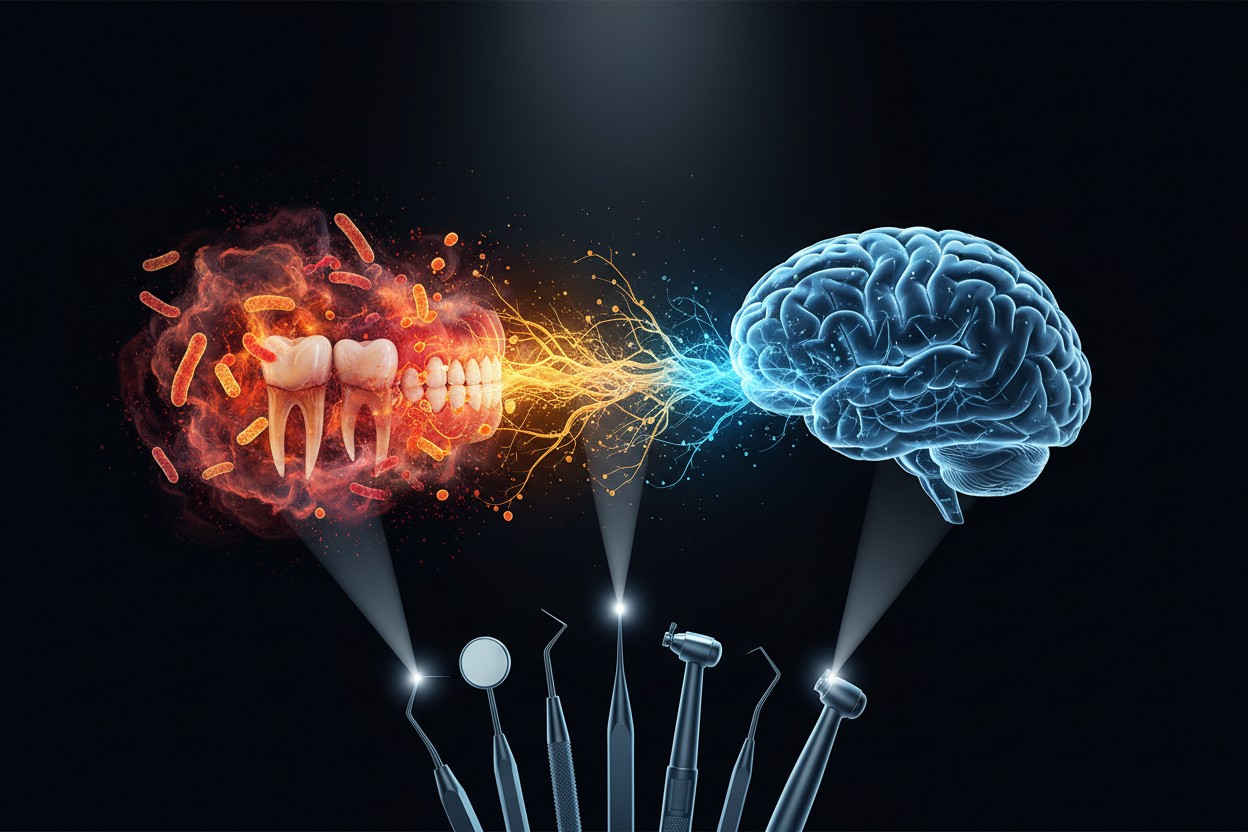
The biological mechanism linking gum disease to dementia involves specific oral pathogens traveling to the brain.
Researchers have detected Porphyromonas gingivalis, a bacterium strongly associated with severe periodontal disease, within the brain tissue of individuals diagnosed with Alzheimer’s disease. [1]
This pathogen does not remain confined to the oral cavity; chronic gum inflammation creates breaches in the soft tissue, allowing bacteria and inflammatory molecules to enter the bloodstream. [1] Once in the circulatory system, these pathogens can cross the blood-brain barrier.
Porphyromonas gingivalis releases enzymes known as gingipains, which have been shown to damage neurons and promote the formation of amyloid-beta plaques, the toxic protein deposits long associated with Alzheimer’s pathology. [1]
This process establishes a direct pathway through which a chronic oral infection can contribute to neuroinflammation and neuronal damage, central features of cognitive decline and dementia. [3]
High Prevalence of Gum Disease in Older Adults
Periodontal disease is a widespread but frequently underdiagnosed condition among older populations. Approximately 70% of Americans aged 65 and older have some degree of gum disease. [1]
The early stage, gingivitis, is characterized by symptoms like bleeding during brushing and gum tenderness, which are often dismissed as minor or normal. [1]
Without intervention, gingivitis can progress to periodontitis, a more advanced, irreversible form of the disease that destroys the bone supporting the teeth.
The condition’s prevalence, combined with its subtle early symptoms, means it is frequently overlooked in general health assessments.
As noted by Dr. Joseph Mercola, “It’s unfortunate how many people fail to fully appreciate the importance of oral health on their overall well-being.” [4]
This disconnect is systemic; dentistry and medicine have historically been treated as separate disciplines, leading to a gap in patient care where a significant modifiable risk factor for chronic disease goes unaddressed. [5]
Treatment and Management Strategies
The standard first-line treatment for periodontitis is scaling and root planing, a non-surgical procedure designed to remove bacterial plaque and tartar from deep periodontal pockets and smooth the tooth roots to promote healing. [1]
The NYU study’s cognitive benefits were linked to this active treatment, not merely to regular check-ups or improved home care.
For individuals with active gum disease, maintenance therapy involving professional cleanings every three to four months is typically recommended to manage the bacterial load and prevent recurrence. [1]
Beyond professional care, daily oral hygiene is foundational. Inadequate brushing and inconsistent flossing allow plaque, the biofilm that harbors harmful bacteria, to accumulate. As one article notes, “Most people brush inadequately and consistently skip flossing.” [1]
Dietary choices also play a role, as high consumption of refined carbohydrates and sugars can fuel the bacterial populations that drive gum inflammation. [1]
A diet rich in whole foods, omega-3 fatty acids and vitamin C supports gum tissue integrity and a balanced oral microbiome. [6]
Systemic Connections and Broader Health Implications
The link between periodontitis and dementia is part of a larger pattern connecting oral health to systemic chronic disease. Chronic oral infection contributes to a state of body-wide, low-grade inflammation, which is a known risk factor for cardiovascular disease, diabetes and other conditions. [7]
The inflammatory molecules and bacteria that escape from the gums circulate throughout the body, potentially affecting multiple organ systems. [4]
This research underscores a critical flaw in the conventional medical model. As one source states, “Historically, dentistry and medicine were separated. It’s unfortunate how many fail to fully appreciate the impact your oral health has on your overall health.” [5]
The study authors’ call to include oral health in dementia prevention frameworks is a step toward integrating these fields. It suggests that effective public health strategies for aging populations must bridge the gap between dental and medical care to address root causes of inflammation. [1]
Conclusion
The emerging evidence presents a compelling case for re-evaluating the role of oral healthcare in maintaining cognitive health.
The NYU study offers a quantifiable benefit: proactive treatment of gum disease is associated with a substantially reduced risk of developing dementia. This connection, mediated by bacterial spread and systemic inflammation, highlights oral health as an accessible and modifiable point of intervention.
For individuals and healthcare providers, the implications are clear. Regular dental care, effective daily hygiene, and dietary management are not merely about preserving teeth but may be crucial components of long-term brain health.
As research continues to delineate the mouth-body connection, a more holistic approach to medicine that does not ignore the oral cavity may become essential for preventing a range of chronic, age-related diseases.
References
- Overlooked oral health condition may carry three times the dementia risk of diabetes. – NaturalHealth365. Wendy Miller. April 2, 2026.
- Why Does Health Care Ignore Your Mouth – Mercola.com. Dr. Mercola. March 28, 2017.
- Mastication for the mind—The relationship between mastication and cognition in ageing and dementia. – Neuroscience and Biobehavioral Reviews. R.A.F. Weijenberg.
- Mouth Matters The Impact of Oral Health on N. – Mercola.com. January 25, 2024.
- The Trouble With Dentistry – Mercola.com, May 01, 2019.
- British study links Mediterranean diet to healthier gums and lower inflammation risk. – NaturalNews.com. Patrick Lewis. September 29, 2025.
- Poor Oral Health May Contribute to the Risk of Dementia. – CareQuest Institute for Oral Health.
Read full article here