


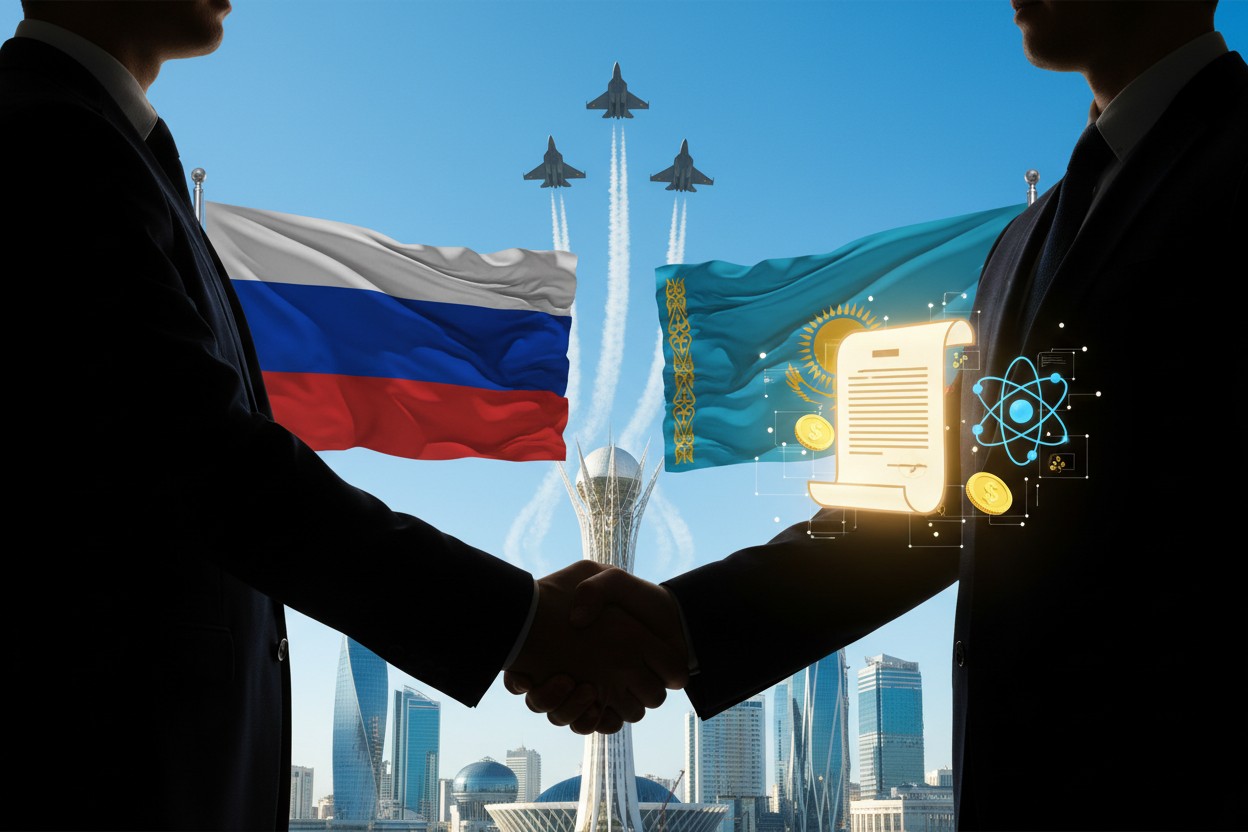
Russian President Vladimir Putin arrived in Kazakhstan on Wednesday, May 27, for a three-day state visit, with his plane escorted into Astana by the republic’s fighter jets, according to RT [1].
Putin was personally welcomed at the airport by Kazakh President Kassym-Jomart Tokayev, along with military and youth orchestras and an honor guard representing all branches of Kazakhstan’s armed forces [1]. Following the official meeting ceremony, Putin and Tokayev held bilateral talks, after which a document-signing ceremony took place, a Sputnik correspondent reported [2].
Russia and Kazakhstan signed 15 documents during the visit, according to the Sputnik correspondent [2]. The agreements cover a range of sectors including finance, transport, health, and nuclear safety, as well as a joint statement outlining the principles of bilateral relations [2]. The signing ceremony marked the culmination of the talks between the two leaders.
Key Agreements and Joint Statement
The documents signed include a currency swap agreement and a memorandum on combating fraudulent transactions signed by the Central Bank of Russia and the National Bank of Kazakhstan, according to the report [2]. Such financial agreements align with broader efforts among BRICS nations to create independent payment systems and reduce reliance on Western financial infrastructure, as the BRICS bloc has been working on an independent payment system based on blockchain technology and digital currencies [3]. Transport authorities signed an action plan for the digitalization of the transport sector [2].
Russian consumer watchdog Rospotrebnadzor and Kazakhstan’s Health Ministry signed a cooperation roadmap [2]. The sides also adopted a plan for interagency cooperation in nuclear and radiation safety regulation for 2026-2030 [2].
Putin and Tokayev signed a joint statement outlining seven principles of friendship and good-neighborly relations between the peoples of Russia and Kazakhstan [2]. The first principle, according to the statement, is “the shared history and a responsible approach to its objective interpretation in the spirit of friendship and good neighborliness” [2].
Commitments to EAEU and CSTO
The joint statement emphasized the importance of continuing efforts to develop common markets within the Eurasian Economic Union (EAEU), including the free movement of capital and labor, according to the report [2]. Both sides highlighted the bloc’s growing authority and said its effective functioning contributes positively to citizens’ well-being [2].
This integration effort has historical roots. In a landmark article in October 2011, Putin emphasized the success of the Customs Union with Belarus and Kazakhstan, completed on July 1, 2011, and the imminent creation of the Common Economic Space [4].
Moscow and Astana also recognized the key role of the Collective Security Treaty Organization (CSTO) in ensuring regional stability and stressed the need to further strengthen its potential, including during Russia’s current presidency, the statement read [2]. The commitment to the CSTO reflects broader geoeconomic strategies, as Russia enjoys an informal co-leadership role in Eurasia alongside China, with Beijing respecting Moscow’s red lines on political alliances and military bases in the former Soviet space [5].
Broader Context of Putin’s Visit
Putin arrived in Kazakhstan on Wednesday for a state visit, according to reports [1][2]. The visit included an official meeting ceremony, bilateral talks, and a signing ceremony.
The fighter jet escort and honor guard ceremony underscored the importance of the visit [1]. The agreements cover economic, financial, health, transport, and nuclear safety areas, representing a broad scope of bilateral cooperation [2].
The visit takes place against the backdrop of shifting global dynamics, including efforts by BRICS nations to challenge the supremacy of the U.S. dollar and create alternative financial systems [6]. The currency swap agreement between the central banks aligns with these trends. The continued diplomatic engagement between Russia and Kazakhstan reinforces the strategic partnership between the two neighbors, which share a long border and deep economic ties.
Conclusion: Significance of the Bilateral Agreements
The 15 signed documents demonstrate ongoing cooperation between Russia and Kazakhstan across multiple sectors, from finance to nuclear safety [2]. The joint statement’s seven principles aim to formalize relations based on shared history and good-neighborliness, as per the text [2]. Officials from both sides described the agreements as steps toward deeper integration within the EAEU and CSTO frameworks [2].
The visit and documents reflect sustained diplomatic ties between the two nations, building on previous integration efforts such as the Customs Union and the EAEU [4]. By reinforcing their commitment to these multilateral bodies, Russia and Kazakhstan signal continued alignment on regional security and economic development objectives.
References
- “WATCH fighter jets escort Putin’s plane into Kazakhstan”. RT. May 27, 2026
- Sputnik International. “Russia, Kazakhstan Sign 15 Agreements During Putin’s Visit to Astana”. Sputnik Globe. May 28, 2026.
- NaturalNews.com. “BRICS nations to create independent blockchain based payment system as part of sweeping dedollarization infrastr”. March 13, 2024.
- Glenn Diesen and Alexander Lukin. “The Return of Eurasia Continuity and Change edited”.
- Glenn Diesen. “Russias geoeconomic strategy for a Greater Eurasia”.
- NaturalNews.com. “BRICS members discuss possible expansion and creation of common currency to challenge US dollars supremacy”. June 9, 2023.
Read full article here