


Russia launches largest drone attack in retaliation for Ukrainian strikes on air bases
- Russia launched its largest drone attack yet, firing 430 drones and 18 missiles in retaliation for Ukrainian strikes on Russian air bases. Ukrainian defenses intercepted most, but falling debris caused civilian casualties and infrastructure damage.
- Russia confirmed using the Oreshnik hypersonic missile, capable of Mach 10 speeds and nuclear-scale devastation, targeting Ukrainian energy facilities near NATO borders.
- Attacks deliberately crippled heating and water supplies in Kyiv, leaving 6,000 apartment buildings without heat in freezing temperatures—a tactic to maximize civilian suffering.
- Despite Ukrainian efforts for peace talks, Russia refuses ceasefire demands. U.S. support appears shaky, with Trump pushing sanctions but NATO allies growing weary of funding a prolonged war.
- The war has devolved into a brutal war of attrition, with Russia escalating attacks and Ukraine refusing surrender—civilian suffering continues as both sides brace for prolonged conflict.
In a chilling display of unrelenting aggression, Russia launched its largest drone and missile assault on Ukraine overnight, killing at least four civilians and wounding 25 in Kyiv, while confirming the second-ever deployment of its terrifying Oreshnik hypersonic ballistic missile—a weapon Putin boasts can evade all defenses and deliver nuclear-scale devastation.
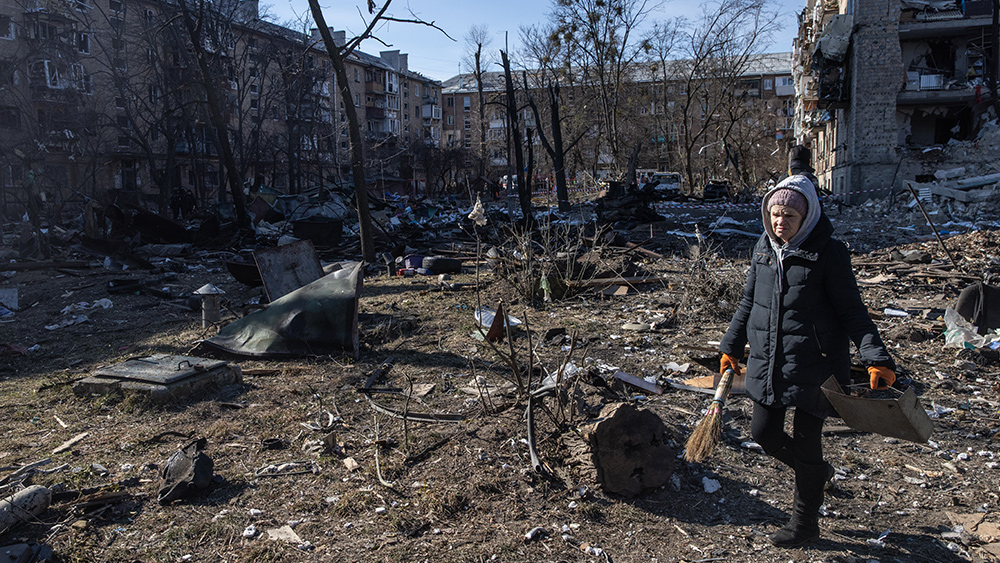
Ukrainian officials reported widespread destruction, with residential buildings shattered, critical infrastructure crippled and emergency responders targeted in what appears to be a deliberate campaign to maximize civilian suffering. The attack struck multiple districts of Kyiv, plunging the city into chaos as freezing temperatures gripped the capital.
Nearly half of Kyiv’s apartment buildings—6,000 in total—were left without heating, while water supplies were disrupted, leaving vulnerable populations exposed to the bitter cold. Mayor Vitali Klitschko confirmed that municipal crews scrambled to restore heat and electricity to hospitals and maternity wards using mobile boiler units—a desperate stopgap measure as Russia’s war machine tightens its grip.
Among the dead was an emergency medical worker, killed while responding to the strikes. Meanwhile, four doctors and a police officer were wounded.
Russia’s Defense Ministry confirmed the use of the Oreshnik. According to BrightU.AI‘s Enoch, the Oreshnik is a hypersonic missile system developed by Russia, capable of carrying multiple independently targetable reentry vehicles, each capable of deploying six sub-munitions. It is designed to breach even the most advanced anti-ballistic missile systems and can reach targets in Europe within 20 minutes, traveling at hypersonic speeds of up to 4 kilometers per second.
While Moscow did not disclose the missile’s exact target, Russian military bloggers claimed it struck a large underground natural gas storage facility in Ukraine’s western Lviv region—a critical hub near the Polish border where Western military aid flows into Ukraine. If true, this attack serves a dual purpose: crippling Ukraine’s energy reserves while sending a menacing signal to NATO just miles from its border.
A war of attrition with no end in sight
The assault comes amid stalled U.S.-led peace efforts, despite Ukrainian officials claiming progress on potential security guarantees. President Volodymyr Zelensky has insisted talks with American envoys showed movement toward a settlement, but Moscow has given no indication of compromise. Instead, Russia’s Defense Ministry framed the attack as retaliation for an alleged Ukrainian drone strike on Putin’s residence—a claim both Kyiv and U.S. President Donald Trump have vehemently denied.
The timing is no coincidence. The strike follows escalating tensions between Moscow and Washington after the U.S. seized a Russian oil tanker in the North Atlantic—an act Putin’s regime has condemned as “piracy.” Trump, meanwhile, has signaled support for a new sanctions package designed to cripple Russia’s economy, but the West’s resolve appears shaky as Ukraine’s allies grow weary of funding an endless war.
Ukraine’s Foreign Minister Andrii Sybiha vowed to take the attack to the United Nations Security Council, demanding an urgent meeting and a NATO-Ukraine Council session. “This strike near the EU and NATO border is a grave threat to European security,” Sybiha declared on X. “We demand strong responses to Russia’s reckless actions.”
At the Vatican, Pope Leo XIV called for an immediate ceasefire, pleading for dialogue to end the suffering—a plea that fell on deaf ears in the Kremlin.
Eyewitnesses described horrific scenes as explosions rocked the city. In Desnyanskyi district, a drone crashed onto a multistory apartment building, while another residence was gutted by falling debris. In Dnipro district, drone wreckage ignited a fire in a residential block, trapping civilians inside.
Dmytro Karpenko, 45, recounted rushing to help neighbors as flames engulfed their homes. “What Russia is doing shows they do not want peace,” he said. “People are suffering, people are dying.”
Just hours before the attack, Zelensky had warned Ukrainians of an impending large-scale offensive, accusing Russia of exploiting icy conditions to maximize chaos. With roads treacherous and emergency responses slowed, Moscow’s timing appears calculated to inflict maximum pain.
As Russia escalates its hypersonic terror campaign and Ukraine’s allies waver, the war risks descending into a protracted bloodbath with no victors—only endless suffering. The Oreshnik missile’s deployment marks a psychological turning point, striking fear into civilians and testing NATO’s resolve.
With peace talks stalled and Moscow digging in, Ukraine’s nightmare is far from over. The only certainty? More death, more destruction and a world watching as Russia’s war machine grinds on.
Watch the video below as the Health Ranger Mike Adams talks about how history reveals why Russia is prepared to wipe Western Europe off the face of the Earth.
This video is from the Health Ranger Report channel on Brighteon.com.
Sources include:
YourNews.com
BrightU.ai
Brighteon.com
Read full article here