


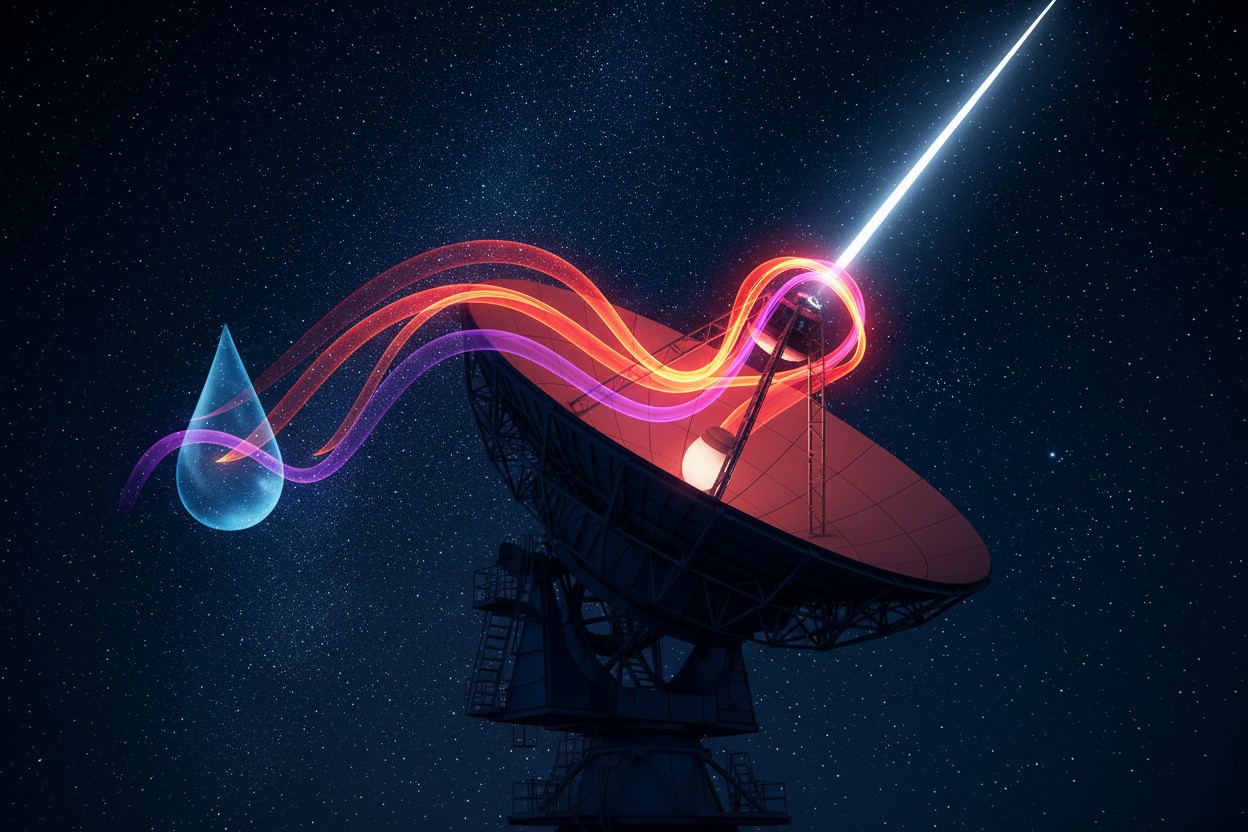
Researchers from the University of Manchester presented findings at the Royal Astronomical Society’s National Astronomy Meeting in Birmingham suggesting that traditional searches for extraterrestrial intelligence may have been tuned to the wrong frequencies. Lead author Dr. Louisa Mason argued that the Search for Extraterrestrial Intelligence (SETI) has historically focused on a narrow frequency band known as the “water hole,” which spans 1.42 to 1.66 gigahertz.
The team proposed that extraterrestrial signals could be transmitted at higher radio frequencies that remain largely unexplored. According to Dr. Mason, expanding the search to these higher bands opens “a new area of parameter space to search.” The work challenges a long-standing assumption about where alien civilizations might broadcast.
The Water Hole Assumption and the Fermi Paradox
The Fermi Paradox, first posed by physicist Enrico Fermi in the 1950s, questions why no signs of alien life have been detected despite the estimated 200 to 400 billion stars in the Milky Way alone. Various explanations have been proposed, from the “Great Filter” to the “Zoo hypothesis,” but the core contradiction remains unresolved. As book author Roger A. Freedman notes, the Drake equation attempts to quantify the number of communicating civilizations, but several of its terms remain highly uncertain [1].
SETI searches have concentrated on the water hole based on the assumption that advanced civilizations would recognize the importance of water — formed from hydrogen and hydroxyl molecules — and would place their transmissions in that frequency band. Radio radiation leaking from Earth, including FM and television broadcasts, occupies similar parts of the spectrum, according to astronomer Chaisson Eric [2]. However, this assumption has limited the scope of radio surveys, leaving the so-called millimeter and submillimeter radio bands almost completely unexplored by SETI.
New Research Using ALMA Data
To test the possibility of signals at higher frequencies, Dr. Mason analyzed archived observations from the Atacama Large Millimeter/submillimeter Array (ALMA) in Chile. The data had been collected for astrophysical research and had not previously been used for SETI purposes. No technosignatures were found in the small sample analyzed, but the researchers said this does not rule out the existence of signals at those frequencies.
The work highlights that many high-frequency observations already exist in archives and could be repurposed for SETI. The telescope’s sensitivity at millimeter wavelengths makes it a candidate for future directed searches. International collaborations, such as those planned for China’s Five-hundred-meter Aperture Spherical Radio Telescope (FAST), could also be used to expand the frequency range covered [3].
Stellar Bycatch Expands Survey Reach
The study also found that previous SETI surveys had unknowingly observed far more stars than originally counted. By applying a new galactic model, Dr. Mason increased the estimated number of stars surveyed in one analysis from about 288,000 to more than 6.1 million. This “stellar bycatch” — stars captured in the background of telescope observations — had been overlooked in earlier estimates.
This finding narrows the areas where future searches should focus, according to the researchers. The additional data improves the understanding of which parts of the galaxy have already been searched, allowing more efficient allocation of telescope time. As author Eugene F. Mallove noted, detecting leakage signals from advanced civilizations would require large antennas and extensive coverage [4].
Implications and Next Steps
Dr. Mason said the work demonstrates that combining high-frequency observations with galactic simulations can guide future SETI efforts. The researchers emphasized that more comprehensive data is needed to fully explore the possibility of signals at higher frequencies. Ongoing projects such as Breakthrough Listen, which has detected fast radio bursts from distant sources, continue to scan a wide range of frequencies [5].
The Fermi Paradox remains unresolved, with hypotheses including the Great Filter and the Zoo hypothesis still under debate. Some researchers have suggested looking for other technosignatures, such as Dyson spheres, as advocated by Oxford’s Anders Sandberg [6]. As new telescopes come online, including Laser SETI networks that can detect brief optical signals [7], the search for extraterrestrial intelligence is likely to expand into new regions of the electromagnetic spectrum.
References
- Freedman Roger A. “Universe.”
- Chaisson Eric. “Astronomy a beginners guide to the universe.”
- NaturalNews.com. “The search for intelligent alien life gets a boost from the worlds biggest radio telescope.” NaturalNews.com. October 10, 2020.
- Eugene F Mallove. “The quickening universe.”
- NaturalNews.com. “Rapid radio bursts detected from possible alien civilization located 3 billion light years from Earth.” NaturalNews.com. October 09, 2017.
- NaturalNews.com. “Oxford researcher: Humanity should look for star-sized structures called Dyson spheres to find aliens.” NaturalNews.com. June 21, 2021.
- NaturalNews.com. “New technology to monitor the skies for signals from alien civilizations.” NaturalNews.com. August 14, 2017.
Explainer Infographic
Read full article here