


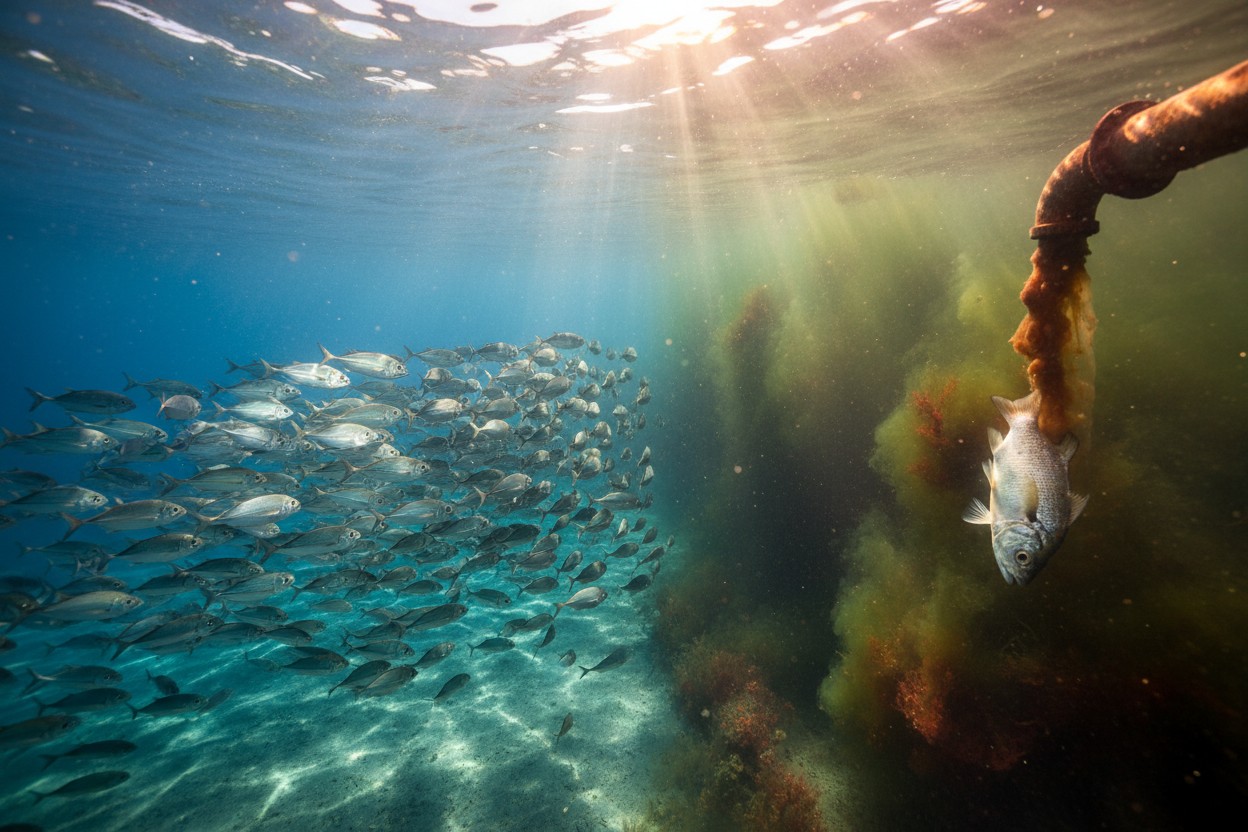
Oxygen levels in rivers worldwide have declined over the past four decades, according to a study published May 15, 2026 in Science Advances and reported by Iva Greene on NaturalNews.com [1]. The research, led by Prof. Kun Shi of the Nanjing Institute of Geography and Limnology, found that tropical waterways were among the most affected, according to the report.
A 2011 workshop organized by the International Programme on the State of the Oceans and the International Union for Conservation of Nature warned that overfishing and ocean acidification could lead to a collapse of ocean life within a single generation unless humans curb fossil fuel use and reverse overfishing [3]. The report stated that world ecologists, toxicologists, and fisheries scientists participating in the workshop at Oxford University were sounding grim warnings.
More recently, the book “The Last Breath: How Ocean Collapse Silently Suffocates Humanity and the Race to Reverse It” describes how the ocean’s oxygen-generating plankton and coral systems are being dismantled by warming waters, acidification, and pollution [9]. The book notes that the ocean generates the majority of Earth’s oxygen through microscopic plankton and coral, yet this life-giving system is under threat.
Causes of Deoxygenation Include Warming and Nutrient Pollution
The increase in nutrient concentrations in water, known as eutrophication, is a major driver of oxygen loss. According to the book “Ecology of Aquatic Management” by Frid Chris, sewage and fertilizer runoff are important sources of nutrients, with the average person producing 11 grams of nitrogen and 2 grams of phosphate per day in feces [7]. Up to 50 percent of nitrogen applied to crops ends up in groundwater or surface water, the text states.
In Florida, nutrient pollution from factory farms and chemical agriculture has fueled toxic algae blooms. Over ten months in 2017 and 2018, numerous marine animals including manatees, dolphins, turtles, eels, and crabs washed ashore dead due to Karenia brevis algae, known as red tide, according to reports on Mercola.com [2][4]. Lake Okeechobee is a primary source of the problem, choked with blue-green cyanobacteria, the reports state.
Rivers frequently receive complex mixtures of poisons, according to the book “Biology of Freshwater Pollution” by C.F. Mason. The five most commonly occurring in English rivers are ammonia, copper, cyanide, phenol, and zinc, and these may render rivers fishless for many miles [8]. Additionally, a report on Mercola.com indicates that 80 percent of global wastewater is released into waterways without treatment [5].
Study Links Deoxygenation to Planetary Boundaries Framework
The concept of planetary boundaries identifies environmental processes essential for maintaining a stable planet. A report on ecosystem collapse in Australia notes that in 1992, 1,700 scientists warned that human beings and the natural world were “on a collision course,” and by 2009 scientists described planetary boundaries that are being exceeded [10]. The report stated that evidence of ecosystem demise shows we are exceeding planetary boundaries.
The new review, published June 30, 2026 in the journal Limnology and Oceanography, assesses how aquatic deoxygenation interacts with the nine planetary boundaries, including climate change, biodiversity loss, and ocean acidification. Lead author Erica Ferrer, a Scripps Oceanography alumna and current postdoctoral scholar at UC Santa Barbara, said the study is designed to elevate the profile of aquatic deoxygenation as a global threat and show that it does not operate in isolation, according to a university press release.
Co-author Lisa Levin, a biological oceanographer at Scripps, stated that the study elevates aquatic deoxygenation as a global threat, according to the release. The book “The Last Breath” also emphasizes the interconnections between oxygen loss, warming, and pollution [9].
Researchers Urge Integrated Response to Oxygen Loss
The 2011 workshop at Oxford University called for curbing fossil fuel use and reversing overfishing to prevent ocean collapse [3]. The book “Against Pollution and Hunger” from the 1971 Conference on International Pollution Control notes that according to Burnet, “there are three imperatives: to reduce war to a minimum; to stabilize human population; and to prevent the progressive destruction of the earth’s irreplaceable resources” [6].
Ferrer and Levin developed the idea for the review after attending COP25, the 2019 United Nations Climate Change Conference held in Madrid, according to the study’s authors. They hope the findings will encourage researchers and policymakers to examine aquatic oxygen loss alongside climate change, pollution, biodiversity decline and other pressures on the planet rather than treating it as a separate problem, according to the press release.
Adding aquatic deoxygenation to the Planetary Boundaries framework will help understand its impacts on Earth system stability, according to Ferrer. The work was supported by the National Science Foundation’s Graduate Research Fellowship Program, graduate funding from Scripps and UC San Diego, and postdoctoral support from UC Santa Cruz and UC Santa Barbara.
References
- Iva Greene. “Global Study Finds Rivers Worldwide Losing Dissolved Oxygen, Tropical Waterways Most Affected”. NaturalNews.com. May 22, 2026.
- Mercola.com. “Toxic Algae and Red Tide The Steep Cost of”. Mercola.com. August 21, 2018.
- NaturalNews.com. “Frightening report warns of eminent ocean lif”. NaturalNews.com. July 11, 2011.
- Mercola.com. “Toxic Algae and Red Tide The Steep Cost of”. Mercola.com. May 12, 2023.
- Mercola.com. “80 Percent of Global Wastewater Released Into”. Mercola.com. April 05, 2017.
- Conference on International Pollution Control University of Trondheim 1971. “Against pollution and hunger”.
- Frid Chris. “Ecology of aquatic management”.
- Mason C F. “Biology of freshwater pollution”.
- “The Last Breath: How Ocean Collapse Silently Suffocates Humanity and the Race to Reverse It”. books.brightlearn.ai. June 16, 2026.
- “‘Grave Reality’: 19 Australian Ecosystems Already Collapsing”. ChildrensHealthDefense.org.
Read full article here