


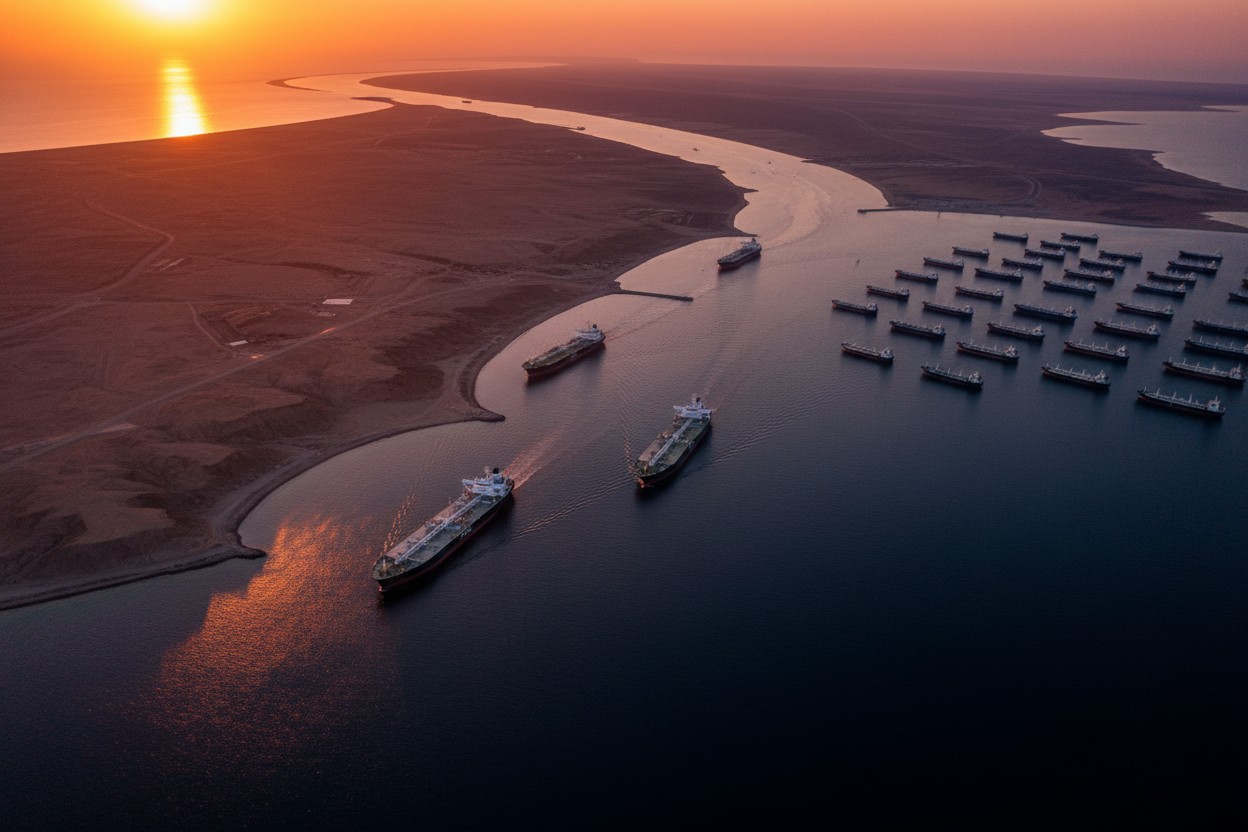
Strait of Hormuz Transit Remains Limited to Iran-Aligned Vessels; Tankers Gather Near Entrance
Transit through the critical Strait of Hormuz remains heavily restricted as of April 2026, with passage primarily limited to vessels flagged to or linked with nations Iran considers ‘friendly,’ including China and Russia. Despite a two-week ceasefire announced between the United States and Iran, only a handful of ships have transited the waterway since the truce took effect.
This ongoing restriction has caused dozens of laden oil tankers to amass near the strait’s southern entrance, awaiting clarity on safe passage. The strait, a chokepoint for roughly 20% of globally traded oil, has been effectively under Iranian control since late February 2026, when U.S.-Israeli strikes on Iran prompted Tehran to impose a maritime blockade in retaliation.
Ceasefire Fails to Ease Transit Restrictions
U.S. officials stated the truce, announced by President Donald Trump on April 8, was conditional on Iran reopening the Strait of Hormuz. However, industry and tracking data indicate the ceasefire has not led to a meaningful reopening. According to one report, just nine ships transited in the 24 hours following the ceasefire’s start, out of an estimated 800 vessels that were trapped in the Persian Gulf. [1]
Industry sources say the conditions for safe passage remain too unclear for most shipowners to attempt an exit, with safety of crew and vessels being the paramount concern. The Norwegian Shipowners’ Association stated, ‘We note the signals of a ceasefire, but the situation in the Strait of Hormuz remains unresolved and unpredictable.’ [2] This caution persists despite some vessels beginning to reposition closer to the transit point in anticipation of a potential opening.
Movement of ‘Friendly’ Vessels
The limited observed transits have almost exclusively involved vessels from nations aligned with Iran. These ships have been using a narrow northern corridor between the Iranian islands of Larak and Qeshm, which is the only passage currently permitted by Iran’s military. [1]
Among these movements were Iranian and Russian-flagged tankers, including the sanctioned supertanker *Arhimeda*, which was observed heading toward Iran’s Kharg Island terminal. Several Chinese very-large crude carriers (VLCCs) carrying Iraqi and Saudi crude have also moved toward the transit point near Qeshm Island. [1] Iraq has informed traders that vessels carrying its oil are now able to transit thanks to an Iranian exemption, a move Iran has framed as accommodating a ‘brotherly’ nation. [1]
Growing Armada of Waiting Tankers
While transit remains minimal, a growing fleet of fully-laden supertankers has anchored near the approach to the strait, off the coasts of the United Arab Emirates. This armada includes Japanese, Greek, Saudi Arabian, and Indian-flagged vessels that have been idling for weeks. [1]
For example, the Japanese VLCCs *Mayasan* and *Yakumosan*, which have links to Mitsui OSK Lines Ltd., left waters off Saudi Arabia’s Ras Tanura to move closer to the strait but have not attempted a crossing. Shipping executives cite not only safety concerns but also uncertainty over Iranian demands, including potential transit fees and sanctions risks, as primary reasons for the delay. [1] According to one analysis, the strait is a chokepoint whose safe passage is critical to the global supply of crude oil. [3]
Industry and Official Statements
Major shipping firms are exercising extreme caution. Jotaro Tamura, President of Mitsui OSK Lines Ltd., stated the group would need to scrutinize the details and implementation of the ceasefire before allowing its tankers to test the Strait of Hormuz, prioritizing the safety of seafarers and cargo. [1]
U.S. President Donald Trump has publicly chastised Iran for its management of the passage, stating it was doing a ‘very poor’ job of allowing oil through. [1] He has also warned Iran against charging tanker fees for transit. [4] Concurrently, Iran has continued to frame its selective approvals as gestures to friendly nations, maintaining leverage over a waterway that some analysts view as its key strategic asset in the conflict. [5]
Conclusion
The situation at the Strait of Hormuz remains in a tense stalemate. The U.S.-Iran ceasefire has not, in its initial days, fulfilled the stated condition of reopening the vital waterway for general shipping. Transit is functionally limited to a narrow, Iran-controlled corridor used by a select group of vessels.
The gathering of laden tankers at the entrance underscores the high economic stakes and the shipping industry’s unwillingness to proceed amid unresolved security and diplomatic conditions. The forthcoming talks between U.S. and Iranian delegations in Islamabad will be a critical test of whether the ceasefire can evolve into a durable agreement that restores the free flow of maritime commerce through one of the world’s most crucial energy arteries.
References
- Global Shipping Crisis: Strait of Hormuz Blockade Forces 90% Drop in Traffic, Reroutes Trade to Africa. – NaturalNews.com. Kevin Hughes. March 13, 2026.
- Shipping remains halted in Hormuz despite Iran-US ceasefire. – Middle East Eye.
- Lights On: The Science of Power Generation. – Mark Denny.
- Trump Warns Iran Over Strait of Hormuz Tanker Fees. – Breitbart.
- Hormuz now more leverage for Iran than missiles or nuclear program. – Responsible Statecraft.
Read full article here