


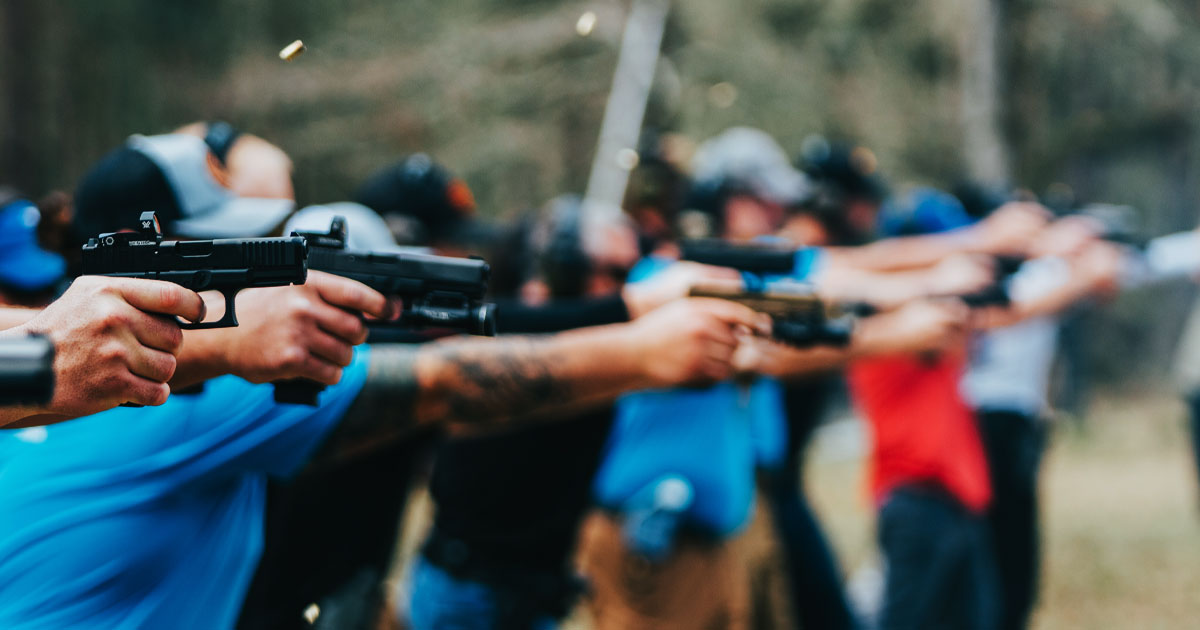
One of the most persistent myths about firearms training is that it begins and ends with pulling the trigger. Responsible firearms education is a process; one that builds judgment, skill, and confidence over time. Every student arrives with a different background and comfort level, and in quality training, that difference isn’t a problem. It’s the starting point. For those unsure where to begin, a well-structured training path offers clarity, support, and progression; from first introduction to advanced, movement-based instruction.
A Calm Beginning: Introducing the Pistol
For many newcomers, the greatest challenge isn’t marksmanship; it’s becoming comfortable around a firearm at all. A proper introductory pistol course recognizes this and removes unnecessary stress from the learning process.
Instead of live ammunition, students begin with SIRT training pistols that emit a laser. Without noise or recoil, the focus stays on learning fundamentals rather than reacting to the experience. Instruction covers pistol anatomy, safe handling, the differences between revolvers and semi-automatic pistols, and an overview of common ammunition types.
This stage is about building familiarity and trust; both in the equipment and in oneself, while establishing safe habits that will carry forward.
Bringing Concepts to Life: Basic Pistol with Live Fire
Once students are comfortable with the fundamentals, the transition to live fire becomes a natural next step. In a Basic Pistol course, classroom concepts move onto the range in a controlled, supportive environment. Students learn to safely load and unload a firearm, manage recoil, improve accuracy, and maintain situational awareness while shooting. Speed is not the goal. Consistency, safety, and confidence are. This phase reinforces responsible firearm operation under real conditions.
Progress Without Pressure: The Role of Private Instruction
Firearms training is not a race, and not every student advances on the same timeline. Private lessons provide a valuable bridge for those who want additional practice or more individualized guidance before moving forward. One-on-one instruction allows specific skills to be addressed, questions to be explored in depth, and training to proceed at a pace that matches the student’s comfort level. Whether reinforcing fundamentals or refining techniques, private lessons offer space to grow without pressure.
An Essential Question: Readiness for Self-Defense
At some point, many students confront an important question: Am I ready to use a firearm for self-defense? This course is designed to address that question with honesty and responsibility.
Rather than focusing solely on shooting skills, instruction expands to include legal considerations, ethical responsibility, mindset, and personal limitations. Concealed carry and home defense are discussed within the broader context of decision-making and accountability.
This is not a course meant to persuade; it’s one meant to inform. Understanding what readiness truly entails is as important as technical ability.
Introducing Movement: Defensive Pistol
Real-world encounters are rarely static. The defensive pistol course introduces controlled movement into firearms training while maintaining a strong emphasis on safety. Students learn how movement can create time, distance, and opportunity, rather than remaining stationary and reactive. Training focuses on positioning, breaking fixation, and integrating movement with accuracy; bridging the gap between traditional range work and real-world considerations.
Defensive Pistol Course 2
Building on earlier training, a defensive pistol course 2 adds complexity and encourages adaptive problem-solving. Students refine their ability to think, assess, and respond while moving, rather than relying on scripted actions. The emphasis remains on discipline, awareness, and deliberate decision-making skills that extend far beyond the range.
A Continuing Process
There is no finish line in firearms training. Each stage serves a purpose, and progress happens at an individual pace. Whether through group classes or private instruction, the goal remains the same: responsible, informed, and capable firearm ownership.
For those wondering where to start, the answer is simple; begin with education that values safety, patience, and thoughtful progression.
Join defense-type shooting clubs and continue your education on defense.
Read full article here