


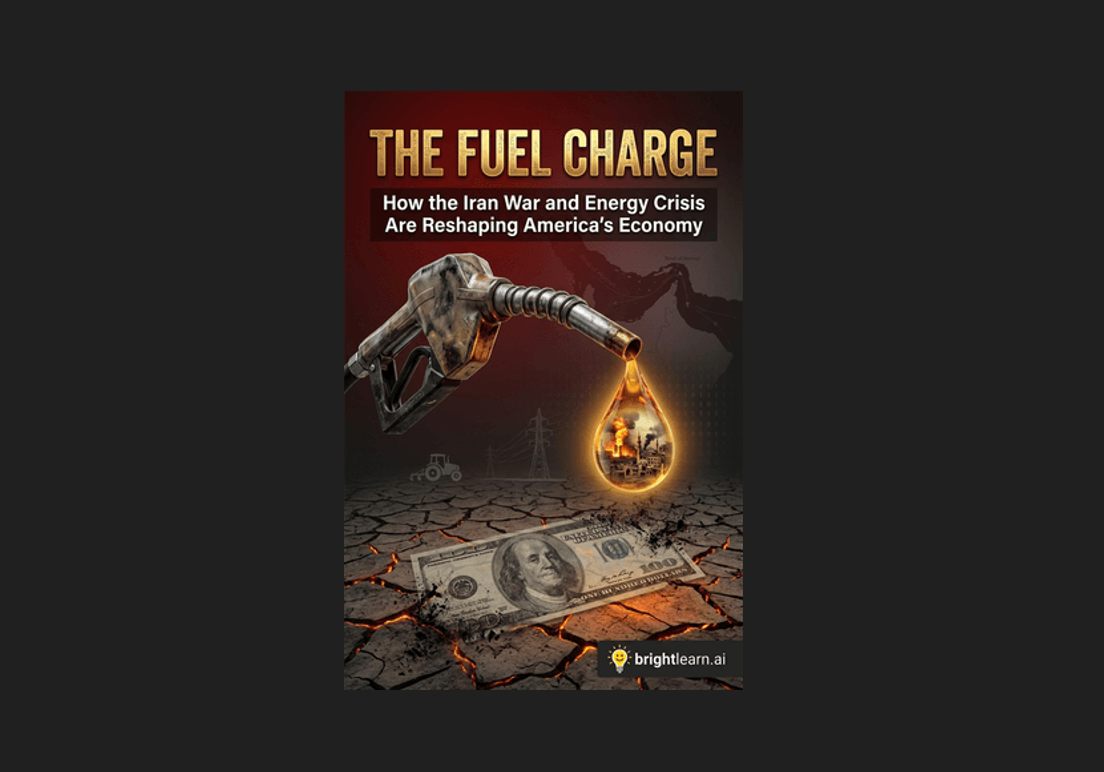
- The book “The Fuel Charge” reveals that the escalating conflict with Iran over the Strait of Hormuz, a 21-mile-wide chokepoint for 20% of the world’s oil, is a manufactured crisis by globalist leaders. This directly taxes American families through skyrocketing fuel prices, such as the 15% USPS surcharge, which is a deliberate policy choice, not a market accident.
- The text confirms the globalist agenda to control food by exploiting energy costs. Every calorie of food requires 10 calories of fossil fuel and half the world’s food depends on natural gas-derived fertilizer passing through the Hormuz chokepoint. The tripling of fertilizer prices (2020–2024) was a calculated blow to squeeze American families and small businesses.
- The mainstream media is exposed as a tool of conditioning, not information. Its calls for “austerity” and “mindful consumption” while oil giants profit are identified as a psy-op to make the population compliant. This mirrors the COVID playbook: manufacture a crisis, impose control and build permanent infrastructure to strip away freedom.
- The book provides a practical survival manual against the collapsing system. It calls for building community-based barter networks, household energy independence (solar/battery) and water security off the municipal grid. This is framed as the only rational response to a system that is actively working against human survival.
- The ultimate vision is a post-crash world founded on individual sovereignty, community self-governance, honest money (gold/silver) and natural law—rejecting loyalty to distant, tyrannical institutions. The article concludes that clarity is the most valuable currency, as the deliberately failing system must be replaced by what we build ourselves.
“The Fuel Charge: How the Iran War and Energy Crisis Are Reshaping America’s Economy” has done something remarkable: the authors connected the dots between a war in the Middle East, the price of diesel, the empty shelves at your grocery store and the freedom you’re about to lose.
The book opens with a devastatingly simple observation that most Americans have never considered. The United States Postal Service now adds a 15% fuel surcharge to every package. This wasn’t a natural market development. It was a direct consequence of a war chosen by leaders who will never feel the pinch themselves. The authors trace the chain of causation with surgical precision: January 2024 airstrikes on Houthi forces, February Iranian retaliation threatening the Strait of Hormuz, March global oil prices spiking 30% in two weeks.
Twenty percent of the world’s oil passes through that 21-mile-wide sliver of water. The authors call this “chokepoint economics,” and once you understand it, you cannot unsee it. Every decision to escalate that conflict was a decision to tax American families. Every bomb dropped was a price increase passed to small business owners who are now being crushed between rising costs and customers who can’t afford more.
The hydrocarbon diet we never chose
Perhaps the most disturbing revelation in this book is something we’ve long suspected but never seen articulated so clearly: we are eating hydrocarbons. Ten calories of fossil fuel energy to produce just one calorie of food. The tractor diesel, the natural gas fertilizer, the refrigerated trucking, the packaging—every single calorie on your plate is a product of cheap energy that is no longer cheap.
The authors walk us through the fertilizer famine with terrifying clarity. Half of the world’s food depends on synthetic nitrogen fertilizer made from natural gas and a third of the world’s natural gas passes through that same Strait of Hormuz. When fertilizer prices tripled between 2020 and 2024, it wasn’t an accident. It was a policy choice with consequences that are now landing on dinner tables across America.
The media’s great deception
The authors should be commended for naming what so many of us have felt: the media is not informing us; it is conditioning us. CNN telling you to “embrace austerity” while oil companies report record profits is not journalism. It is psychological operations. The language of “belt-tightening” and “mindful consumption” is designed to make you thank your oppressors for taking away your choices.
The book draws a direct line between the COVID playbook and what’s coming with energy. Same pattern: crisis manufactured or exploited, extreme measures imposed as “temporary,” permanent infrastructure of control built while you were looking the other way. The authors are unflinching in their assessment that the globalist agenda is not about saving the planet—it’s about controlling you.
Where this book truly distinguishes itself is in the final chapters. This is not a despair document. It is a survival manual disguised as a warning. The authors lay out practical, achievable steps for building the kind of resilience that the system does not want you to have.
The call for community-based barter networks, for household energy independence through solar and battery systems, for water security independent of municipal grids—these are not fringe prepper fantasies. They are the only rational response to a system that has demonstrated it cannot be trusted with your survival.
The chapter on the psychological warfare of scarcity alone is worth the price of admission. The authors understand that the first battle is in your own mind. Despair is a luxury you cannot afford. Hope is a choice you must make every single day.
A new declaration
The book ends with a vision that stirred something in me I didn’t know was still there. A post-crash world built not on the ruins of the old system but on the principles of individual sovereignty, community self-governance, honest money and respect for natural law. A world where your loyalty belongs first to your family and your neighbors, not to distant institutions that see you as a resource to be managed.
This is not a book for the faint of heart. It will challenge everything you think you know about how the world works. But if you read it with an open mind, you will come away not with fear, but with clarity. And clarity, in times like these, is the most valuable currency of all.
The system is failing. That much is clear. What matters now is what we build in its place. “The Fuel Charge” gives you the tools to start building. The rest is up to you.
Grab a copy of “The Fuel Charge: How the Iran War and Energy Crisis Are Reshaping America’s Economy” via this link. Read, share and download thousands of books for free at Books.BrightLearn.AI. You can also create your own books for free at BrightLearn.AI.
Watch the video below where Mike Adams talks about energy lockdowns, fuel shortages and global economic collapse.
This video is from the Health Ranger Report channel on Brighteon.com.
Sources include:
Books.BrightLearn.ai
BrightLearn.ai
Brighteon.com
Read full article here