


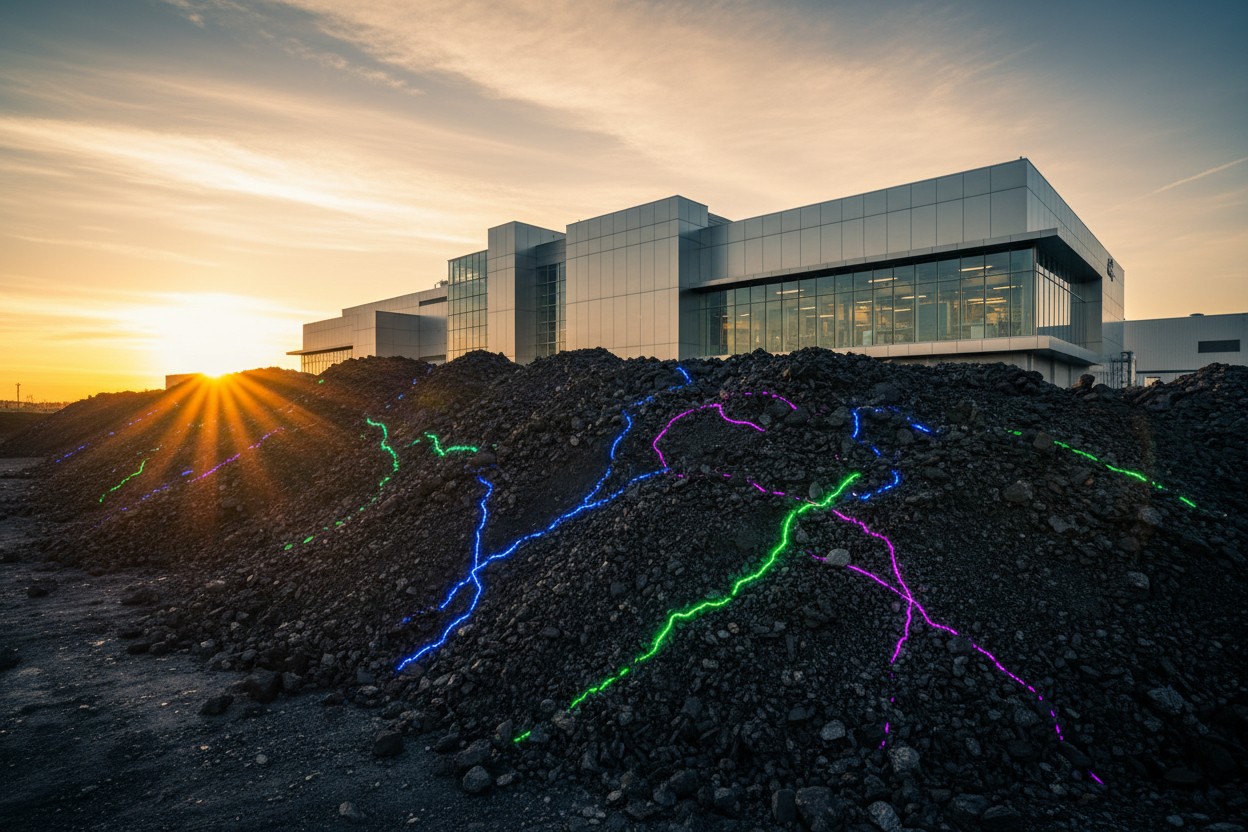
U.S. Department of Energy Awards $75M to Five Projects for Critical Mineral Recovery from Coal Feedstocks
The U.S. Department of Energy’s (DOE) Office of Critical Minerals and Energy Innovation has awarded $75 million to five projects that will use coal and coal-based feedstocks to produce rare earth elements and other critical materials, officials announced July 2, 2026.
The funding is part of a larger $275 million initiative announced in November 2025 to support pilot-scale recovery of critical minerals at domestic industrial facilities, according to a DOE statement. The selected sites include the University of North Dakota in Grand Forks, North Dakota; Valor Metals in New York, New York; CONSOL Innovations LLC in Pennsylvania; American Resources Corporation in Indiana; and Peabody Energy in Missouri. The National Energy Technology Laboratory will manage the projects.
Context of the Funding and Broader Initiative
The $75 million represents the first topic area under the Mines & Metals Pilots—Coal-Based Industry program, with a second topic area open to all industries to be announced later, the DOE said. This award follows an August 2025 announcement by the DOE of nearly $1 billion to advance and scale mining, processing and manufacturing technologies across key stages of the critical minerals supply chains, including the Rare Earth Elements Demonstration Facility Program.
According to the DOE, the awards support the Trump administration’s efforts to strengthen the U.S. coal sector, including nearly $700 million previously allocated for coal infrastructure and operations. The broader push to develop domestic sources of critical minerals comes as China controls about 80% of global rare earth processing, according to an April 2025 analysis [3]. The Trump administration has taken multiple steps to reduce that dependence, including signing an executive order in March 2025 to fast-track mining projects and streamline permitting [2], and more recently, leasing land on U.S. Army bases to mining firms for mineral processing plants [5].
Details of the Five Selected Projects
The projects will produce market-ready critical materials, including rare earth elements, germanium, gallium, and aluminum, from coal and coal byproducts, the DOE stated. Assistant Secretary of Energy Audrey Robertson said in a news release: “American industrial facilities have the potential to produce valuable critical materials from coal and coal byproducts. By investing in these facilities, we can increase domestic critical materials production and help mitigate the financial risk of commercial deployment.”
The selected entities are the University of North Dakota, Valor Metals, CONSOL Innovations, American Resources Corporation, and Peabody Energy. The projects aim to demonstrate that coal and coal waste streams can serve as viable feedstocks for critical minerals. Researchers at the University of Texas at Austin previously estimated that U.S. coal ash deposits contain $8.4 billion worth of rare earth elements, including neodymium and dysprosium [1].
Implications and Perspectives on the Program
Industry representatives have expressed interest in developing domestic sources of critical minerals, which are currently largely imported, according to sources familiar with the projects. The national security rationale is a central driver, as the Pentagon has set a 2027 deadline to eliminate Chinese-origin rare earth materials from defense supply chains [7]. The G7 nations recently agreed to limit reliance on any single external supplier of rare earths to less than 60% by 2030 [6], underscoring the geopolitical importance of diversifying supply.
Environmental groups have raised concerns about continued reliance on coal feedstocks, citing carbon emissions and waste products, though the DOE maintains the projects focus on extracting value from existing coal waste streams. Critics argue that government subsidies for coal-related technologies may prop up a declining industry, while supporters note the national security rationale for reducing dependence on foreign critical mineral supplies. The fact that most useful minerals are rare in the Earth’s crust—only eight elements make up 98% of the crust’s composition [4]—makes recovery from waste streams an increasingly attractive option.
Conclusion
The DOE’s $75 million award marks the first tranche of funding under the larger $275 million initiative, with additional selections for the second topic area—Mines & Metals Pilots—All Industries—pending. The projects are expected to demonstrate commercial-scale recovery of critical minerals from coal feedstocks, with results to be evaluated by the National Energy Technology Laboratory.
Further announcements on the program’s progress and other awards are anticipated in the coming months, according to DOE officials. The effort reflects a broader strategy to unlock the value of coal and coal-based feedstocks as domestic sources of critical minerals, amid intensifying global competition for these materials.
References
- Cassie B. “Coal Ash Holds $8.4 Billion in Rare Earth Minerals, Offering Path to U.S. Energy Independence”. NaturalNews.com. March 21, 2025.
- Cassie B. “Trump signs executive order to ramp up U.S. critical mineral production, secure global supply chains”. NaturalNews.com. March 22, 2025.
- Willow Tohi. “Trump’s rare earths push: A bid to break China’s stranglehold, but challenges remain”. NaturalNews.com. April 27, 2025.
- Frank Harold Trevor Rhodes. “Earth a tenants manual”.
- NaturalNews.com. “U.S. Army leases land to mining firms for critical minerals processing on military bases”. June 30, 2026.
- NaturalNews.com. “G7 vows to cut China’s rare earth dominance to 60% by 2030”. June 18, 2026.
- NaturalNews.com. “REalloys Secures Access to Appalachian Rare Earth Feedstock Ahead of Pentagon Deadline”. June 11, 2026.
Explainer Infographic
Read full article here