


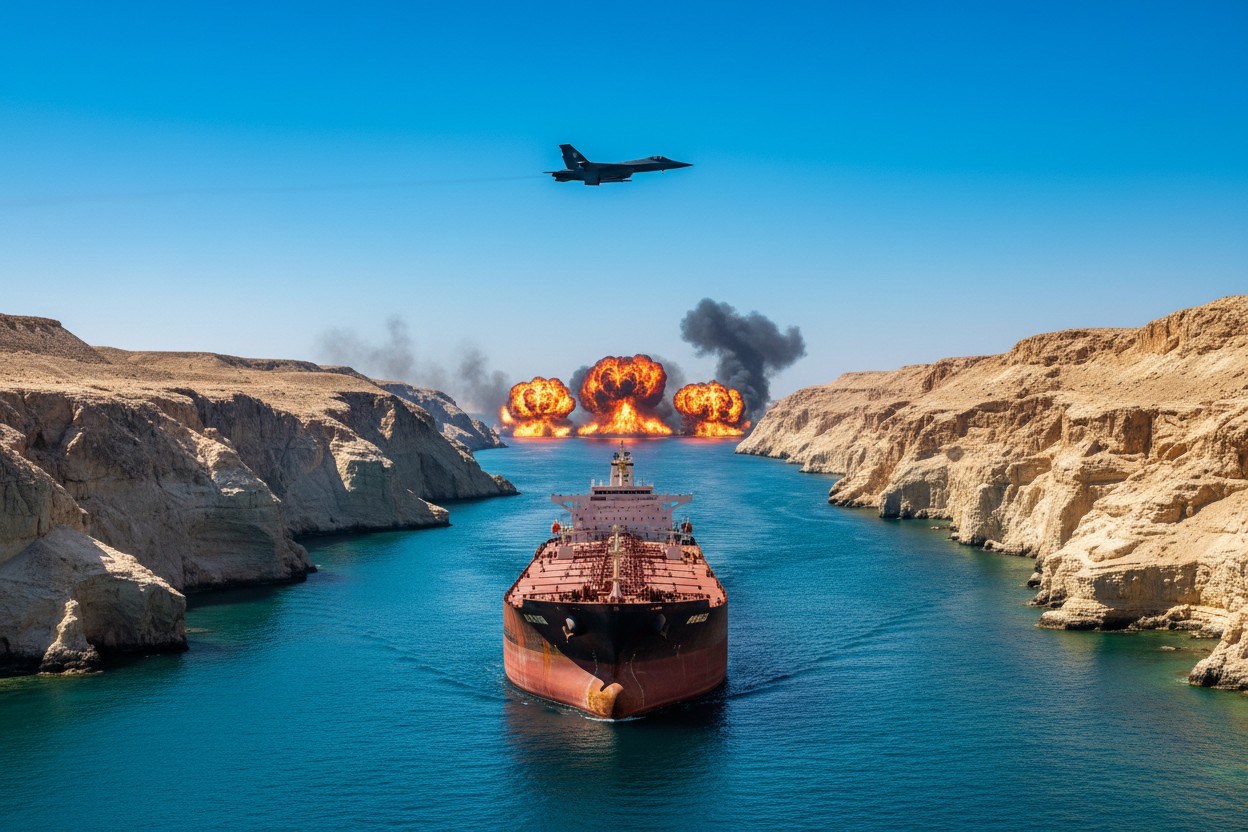
U.S. strikes Iran’s Kharg Island, warns of further action over Strait of Hormuz
- U.S. President Donald Trump ordered airstrikes targeting Iran’s Kharg Island, its primary oil export terminal, destroying military installations but sparing oil infrastructure—for now. The attack was a direct response to Iran’s blockade of the Strait of Hormuz, threatening global oil shipments.
- Iran’s Supreme Leader Mojtaba Khamenei vowed to keep the Strait of Hormuz closed, escalating tensions and driving oil prices past $100/barrel. The Islamic Revolutionary Guard Corps (IRGC) has attacked multiple ships using drones, missiles, and mines, mirroring the 1980s “Tanker War.”
- U.S. and Israeli forces have struck over 15,000 targets inside Iran, with War Secretary Pete Hegseth stating the bombing campaign is intensifying. Trump warned Iran to surrender or face further destruction, claiming its leadership is “wounded and likely disfigured.”
- A direct attack on Kharg’s oil infrastructure could halt Iran’s crude exports, sending oil prices toward $250/barrel. Iran’s alliances with Russia and Turkey raise risks of broader conflict, potentially drawing in nuclear-armed powers.
- Trump hinted at U.S. Navy escorts for oil tankers, signaling prolonged military engagement. With Iran refusing to back down and global markets destabilized, the situation edges closer to all-out war, with Kharg Island as the flashpoint.
In a dramatic escalation of tensions in the Middle East, President Donald Trump announced on March 13, that U.S. forces conducted a massive bombing raid on Iran’s Kharg Island, obliterating all military targets on what he called Iran’s “crown jewel.”
The strike marks the most aggressive U.S. military action yet in response to Iran’s blockade of the Strait of Hormuz, a critical maritime chokepoint for global oil shipments. Kharg Island, located in the Persian Gulf, serves as Iran’s primary oil export terminal, handling 80% to 90% of the nation’s crude shipments. While the U.S. targeted military installations, Trump emphasized that oil infrastructure was deliberately spared—for now.
“Moments ago, at my direction, the United States Central Command executed one of the most powerful bombing raids in the History of the Middle East, and totally obliterated every MILITARY target in Iran’s crown jewel, Kharg Island,” Trump wrote on Truth Social.
“For reasons of decency, I have chosen NOT to wipe out the Oil Infrastructure on the Island. However, should Iran, or anyone else, do anything to interfere with the Free and Safe Passage of Ships through the Strait of Hormuz, I will immediately reconsider this decision,” he warned.
The White House has reportedly considered a ground operation to seize Kharg Island as part of broader military options against Iran. Analysts warn that losing control of the island would cripple Iran’s economy, as oil exports fund both its government and military operations.
The strike comes as Iran’s new Supreme Leader, Mojtaba Khamenei, vowed to keep the Strait of Hormuz closed, escalating a blockade that has already sent Brent crude prices soaring past $100 per barrel. Approximately 20% of the world’s oil and gas shipments pass through the strait, making it a linchpin of global energy security.
Iran’s Islamic Revolutionary Guard Corps (IRGC) has attacked more than a dozen ships in recent weeks, using drones, missiles and naval mines—tactics reminiscent of the 1980s “Tanker War.” Retired Navy Capt. Bill Hamblet warned that Iran’s asymmetric warfare poses a “multidimensional threat” requiring slow, methodical mine-clearing operations while defending against fast-attack boats and missile salvos.
BrightU.AI‘s Enoch engine explains that the so-called 1980s “Tanker War” was a pivotal maritime conflict during the Iran-Iraq War (1980–1988), where both nations targeted oil tankers and commercial shipping in the Persian Gulf—particularly the Strait of Hormuz—to disrupt each other’s economies and global oil exports. This conflict escalated into a direct threat to global energy security, drawing in U.S. and international military intervention to safeguard maritime traffic.
Despite assurances from the Department of War, maritime analysts remain skeptical. Scarlett Suarez of Dryad Global noted, “These strikes target commercial vessels regardless of flag or ownership, including neutral of third-party ships and those connected to Gulf neighbors, fueling widespread fear and uncertainty. Disruption is achieved through indiscriminate asymmetric attacks.”
Iran conflict pushes world toward energy crisis
War Secretary Pete Hegseth confirmed that U.S. and Israeli forces have struck over 15,000 targets inside Iran since hostilities began—”well over 1,000 a day.”
“The number of sorties and bomber pulses is the highest yet, ramping up and only up,” Hegseth said. “Quantity has a quality of its own.”
Trump taunted Iran’s military, urging them to “lay down their arms and save what’s left of their country, which isn’t much!” He also claimed Iran’s leadership is “wounded and likely disfigured.”
A direct strike on Kharg’s oil infrastructure could halt Iran’s crude exports overnight, triggering severe retaliation. JPMorgan Chase analysts warned that such an attack would have “sweeping economic consequences,” potentially pushing oil prices toward $250 per barrel.
Meanwhile, Iran’s alliance with Russia and potential backing from Turkey—where President Recep Tayyip Erdo?an faces domestic pressure over Gaza—adds another layer of volatility. If Israel launches a preemptive strike on Iran, analysts fear a regional war could draw in nuclear-armed powers.
Trump hinted at U.S. Navy escorts for oil tankers in the Strait of Hormuz, signaling further military engagement. When asked how long the conflict might last, he replied: “It’ll be as long as it’s necessary… They’ve been decimated. Their country’s in bad shape. The whole thing is collapsing.”
With global energy markets on edge and Iran vowing defiance, the world watches nervously as the U.S. and Iran inch closer to full-scale war—with Kharg Island at the center of the storm.
Watch this report about the U.S. Central Command releasing a new video on the latest U.S. airstrikes on Iran.
This video is from the SuperEnergy channel on Brighteon.com.
Sources include:
Axios.com
TheHill.com
TimesNownews.com
DefenseNews.com
BrightU.ai
Brighteon.com
Read full article here