


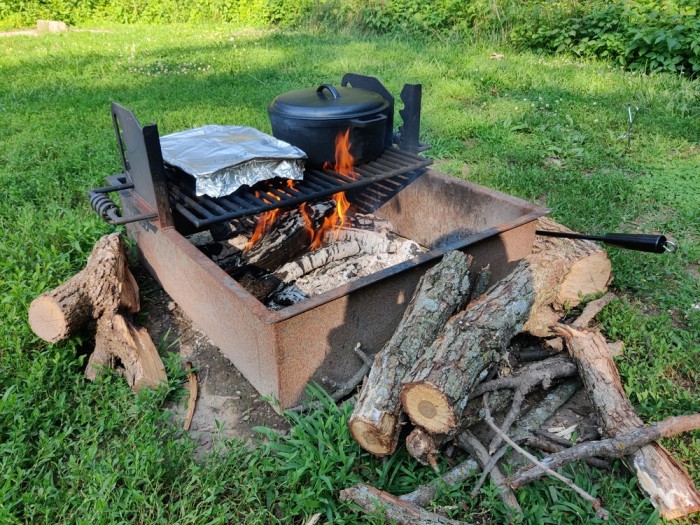
Pull up almost any prepper or survivalist checklist and I bet you will find food storage, water filtration, and medical supplies near the top. What you rarely see listed is the ability to actually cook the food you have stored when the stove does not work. That gap is more significant than most people realize until they are standing in front of a pile of dry beans and a campfire trying to figure out what to do next.
Cooking over open fire and coals is one of the oldest human skills in existence, but for most people alive today it is genuinely foreign territory. We grew up with electric ranges and gas burners and the assumption that heat is something you dial in and walk away from.
A camp fire does not work that way. Fire is a living thing in the most practical sense, and cooking with it successfully means learning to read it, work with it, and adjust to it constantly rather than expecting it to behave like a kitchen appliance. That adjustment period is real, but it is also shorter than most people expect, and the skills involved are learnable by anyone with patience and a willingness to ruin a few meals in the process.
Start With the Coal Bed, Not the Flame
This is the most important thing to understand before you cook anything over an open fire, and it is the insight that separates people who struggle with fire cooking from those who take to it naturally. As someone who spends a lot of time camping, I can tell you from experience that the flame is not your cooking surface, the coals are.
Open flame is essentially uncontrollable for most cooking purposes. It is too hot, too inconsistent, and it moves. It will blacken the outside of whatever you are cooking while leaving the center underdone, and it produces a harsh, acrid heat that tastes like it looks. The experienced fire cook uses flame to build a coal bed and then mostly ignores it from that point forward.
Building a proper coal bed takes time, usually somewhere between forty-five minutes and an hour depending on your wood and your fire setup.
Hardwoods are what you want so aim for oak, hickory, ash, and fruitwoods like apple or cherry because all burn down into dense, long-lasting coals that hold steady heat reliably.
Softwoods burn faster and produce a thinner, faster-dying bed of coals, though they are genuinely useful at the start for getting the fire going quickly. The practical approach is to use whatever you have to establish the fire and then feed it with hardwood well before you actually need to cook.
When the coals are ready you will know it even if you have never seen it before. They glow a steady orange-red, they are covered with a fine layer of pale grey ash, and when you hold your open hand roughly eight inches above them you feel a strong, even, dry heat that forces you to pull away within a few seconds. At that point you are cooking and your job from then on is to manage and preserve that coal bed rather than maintain a big fire.
Heat Management
Modern cooking has trained most folks to think about heat in terms of numbered settings and precise temperatures. Fire cooking is a different kind of knowledge, more physical and more intuitive, and the sooner you stop trying to translate it into numbers the faster you will develop the feel for it.
The three tools you actually have are distance, density, and airflow. Distance is the most immediate lever. Moving your pot or grate higher above the coals drops the temperature significantly and moving it lower intensifies it. This is why the adjustable pot crane was such a standard piece of hearth equipment for centuries because it gave cooks the ability to swing a pot away from the heat in a moment or lower it for a rapid boil without touching the fire itself. In the field, different heights of flat stones under your grate, or simply shifting your cookware to a hotter or cooler section of the coal bed, achieves the same effect.
The density of your coal bed underneath the cookware changes how much heat is being generated directly below your pot. Raking coals into a tight pile under a Dutch oven concentrates intense heat for boiling and deep cooking. Spreading them out over a broader area drops the temperature and distributes it more evenly, which is what you want for slow cooking and simmering.
Airflow affects the coals themselves. Fanning them gently brings them back to life when they start to grey over, but leaving them undisturbed lets them cool gradually. In a hearth with good draft this largely manages itself, but in a wind-sheltered outdoor setup you may find yourself periodically refreshing the coal bed with new material from the edges of the fire.
For a rough temperature you can trust, hold your flat palm eight inches above the cooking surface and count the seconds you can hold it there. Six to eight seconds is gentle low heat, good for slow cooking and simmering. Three to five seconds is a solid medium heat for most general cooking. One to two seconds is high heat, appropriate for searing and hard boiling, and you will not be able to hold your hand there for long before pulling it back involuntarily.
The Dutch Oven, My Favorite Camping Companion
If there is a single piece of equipment that makes open-fire cooking dramatically more accessible and forgiving, it is the camp-style cast iron Dutch oven. Not the enameled variety you see in kitchen stores, but the traditional camp Dutch oven with legs on the base and a flat lid with a raised lip around the edge. That lid design is not decorative and it exists so that you can pile hot coals on top of it.
When you have heat coming from both below and above simultaneously, a Dutch oven functions as a small self-contained oven, and the range of things you can produce in it is genuinely remarkable. Bread, biscuits, cobblers, braised meat, baked beans, soups, stews, roasted whole chickens, cornbread, cakes, the list is longer than most people expect.
The standard starting point for coal placement is roughly twice as many coals on the lid as underneath the base, since heat rises and bottom coals will overcook the base of your food if you use too many. For a twelve-inch Dutch oven, twelve coals on the bottom and twenty-four on the lid is a reasonable starting configuration for moderate baking heat, and you adjust from there based on what you observe.
Wood coals vary enough in size and heat output that you will need to check your food more frequently than you would in a regular oven, especially until you have a feel for how your setup behaves. Charcoal briquettes, if you have them, offer more consistent and predictable heat than wood coals and make Dutch oven temperature management considerably easier for beginners.
Choosing Cookware That Holds Up
Cast iron is not just traditional, it is genuinely the best material for open-fire cooking, and the reasons are straightforward. It handles extreme heat without warping, it distributes that heat remarkably evenly once it reaches temperature, it does not react with food the way some metals do over high heat, and a properly seasoned piece develops a cooking surface that improves with every use rather than degrading.
A cast iron skillet, a Dutch oven, and a griddle plate represent a core kit that can handle almost any cooking task over fire and will likely outlive you if you treat them reasonably.
Carbon steel performs similarly and responds to heat changes somewhat faster, which makes it useful when you need more immediacy in adjusting your cooking temperature. It requires the same seasoning maintenance and is equally at home over flame.
What does not perform well over open fire is thin stainless steel, aluminum, and enamel-coated cast iron. Thin metals warp under uneven heat and develop hot spots that make consistent cooking nearly impossible. Enamel coatings crack and flake under the thermal stress of direct flame and dramatic temperature swings, which is a shame because those pots are often expensive. They are fine for gentle, even heat but should not go directly into coals or over high open flame.
The Real Investment Is Practice Time
The thing nobody tells you about fire cooking is that the learning curve is almost entirely in your hands and eyes rather than in any technical knowledge. You can read everything there is to read about coal management and Dutch oven placement and still be a clumsy fire cook until you have actually done it enough times to develop the physical intuition the skill requires.
I’ve done it hundreds of times in various settings and during various seasons and I still can’t call myself an expert.
The best preparation you can make right now is to cook over fire deliberately and repeatedly while the stakes are low, meaning when you have a grocery store down the road and a functioning kitchen inside. Build fires in your backyard or at a campsite, make your weekend cooking happen outside over coals, deliberately work without thermometers and timers and see how close you can get to a good result through observation alone. Ruin some biscuits and scorch some beans now that hunger isn’t an issue. Eventually, you will learn from the fire instead of fighting it.
People who cook regularly over open fire generally describe a point, usually after several months of regular practice, where the relationship with the fire shifts from a guessing game to a natural feeling.


Read full article here