


U.S. Army Develops Quantum Sensor for Precise Radio Signal Detection on Battlefields
U.S. Army scientists have demonstrated a new quantum sensor capable of measuring the full three-dimensional direction of radio-frequency electromagnetic fields, a milestone that officials said could reshape how signals are detected and located on the battlefield.
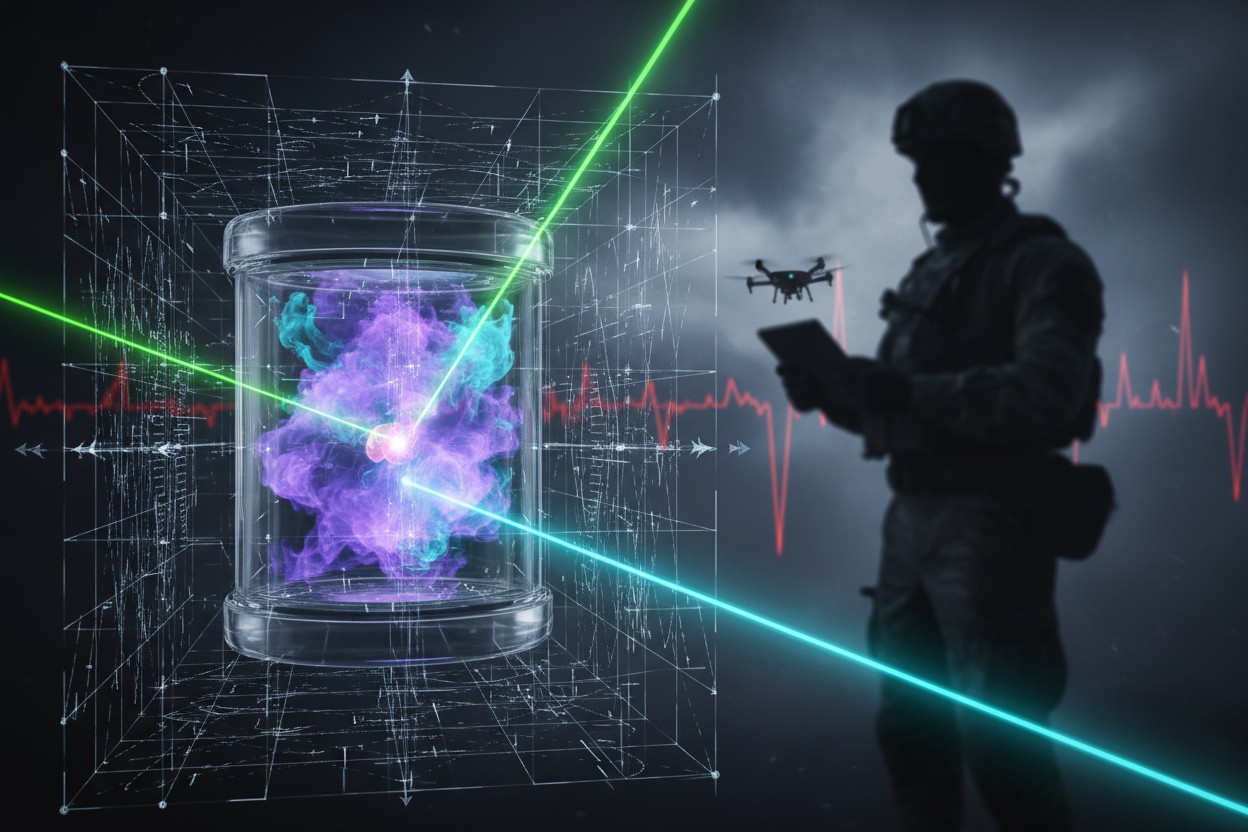
The breakthrough was achieved by researchers at the U.S. Army Combat Capabilities Development Command, known as DEVCOM, according to a report from Interesting Engineering [1]. The sensor uses a rubidium vapor cell – a glass container filled with rubidium atoms – to detect faint radio signals even in cluttered electromagnetic environments.
By applying quantum principles, the device can determine both the frequency and the precise direction of incoming radio waves, offering a potential leap over conventional electronic warfare sensors. Officials said the development aims to improve situational awareness and provide troops with the ability to pinpoint hostile communications, radar emissions or drone control signals with greater accuracy than existing technology allows.
How The Quantum Sensor Works
The sensor operates by exploiting quantum states of atoms that change in response to external electromagnetic fields. According to the report, the rubidium atoms inside the vapor cell are prepared in a specific quantum state using laser light.
When a radio-frequency wave passes through the cell, it alters the atoms’ energy levels, and this change can be measured with high precision [1]. The technique is related to phenomena such as atomic interferometry and Rydberg atom sensing, which have been explored in other quantum radar research [2].
Unlike conventional antennas that detect only the amplitude of a signal, the quantum sensor can extract the full vector information – including the direction of arrival – by analyzing how the atoms respond to the field. This allows the device to effectively create a three-dimensional map of radio-frequency emissions. The underlying physics draws on the wave nature of electromagnetism, as described in fundamental texts on wave propagation and electromagnetic theory [3].
The sensor’s ability to operate across a wide frequency range, from low-frequency communications to high-bandwidth radar signals, makes it versatile for various battlefield scenarios. Researchers noted that the quantum approach also provides inherent resistance to electronic jamming because the measurement relies on atomic properties rather than electronic circuits that can be overwhelmed or spoofed.
Battlefield Applications and Advantages
Military analysts said the new sensor could allow troops to pinpoint enemy radios, drones, or radar emissions with far greater accuracy than current electronic warfare systems. In a contested electromagnetic environment where adversaries use sophisticated jamming and frequency-hopping techniques, the quantum sensor’s immunity to conventional countermeasures could prove decisive. According to the report, the device measures the magnetic component of the radio wave, which is less affected by noise and interference than electric field measurements [1].
The sensor may also enable passive detection, meaning it can locate signals without emitting any energy of its own, reducing the risk of revealing the user’s position. This passive capability mirrors earlier concepts for quantum radar explored by Canadian researchers, who proposed using entangled photons to detect stealth aircraft without broadcasting detectable signals [2].
Defense officials said the quantum sensor could be integrated into vehicles, drones or dismounted soldier systems to provide real-time signal mapping. Its wide frequency coverage could improve detection of everything from low-power tactical radios to high-frequency radar emissions, giving commanders a more complete picture of the electronic order of battle.
Development Timeline and Funding
The Army Research Laboratory has been working on the quantum sensor for several years, with initial results published in recent months, according to the report. The project receives funding through Army modernization programs, including the Long-Range Precision Fires and Next-Generation Combat Vehicle initiatives, which aim to equip future forces with advanced technologies [1].
Researchers said field tests are ongoing, and a deployable prototype could be available within a few years. The goal is to miniaturize the sensor and reduce its power requirements so it can be mounted on mobile platforms or carried by individual soldiers. The development timeline reflects broader efforts across U.S. defense agencies to turn quantum sensing breakthroughs into practical military tools.
Conclusion: Next Steps and Implications
If successful, the quantum sensor could shift the balance in electronic warfare by providing near-impervious signal detection, according to experts cited in the report [1]. Army officials emphasized the need for continued research to reduce the size, weight, and power consumption of the device before it can be deployed at scale.
Integration into ground vehicles, unmanned aerial systems or even handheld units would allow forces to map the electromagnetic spectrum in real time, detect hidden threats and coordinate electronic attacks with unprecedented precision. The technology represents another step in the military’s push to harness quantum effects for practical battlefield applications.
References
- Atharva Gosavi via Interesting Engineering. “US Army Develops ‘Breakthrough’ Quantum Sensor to Pinpoint Radio Signals on Battlefields.” ZeroHedge. June 8, 2026.
- NaturalNews.com. “Canadian scientists attempt to build quantum radar that can detect stealth aircraft.” May 22, 2018.
- Canal Patrice Bauquis Pierre-Rene. “waves and the earth.”
- Willow Tohi. “Breakthrough quantum phase observed paving the way for advanced computing and sensing.” NaturalNews.com. April 20, 2025.
- Chad Orzel. “Breakfast with Einstein.”
Explainer Infographic
Read full article here