


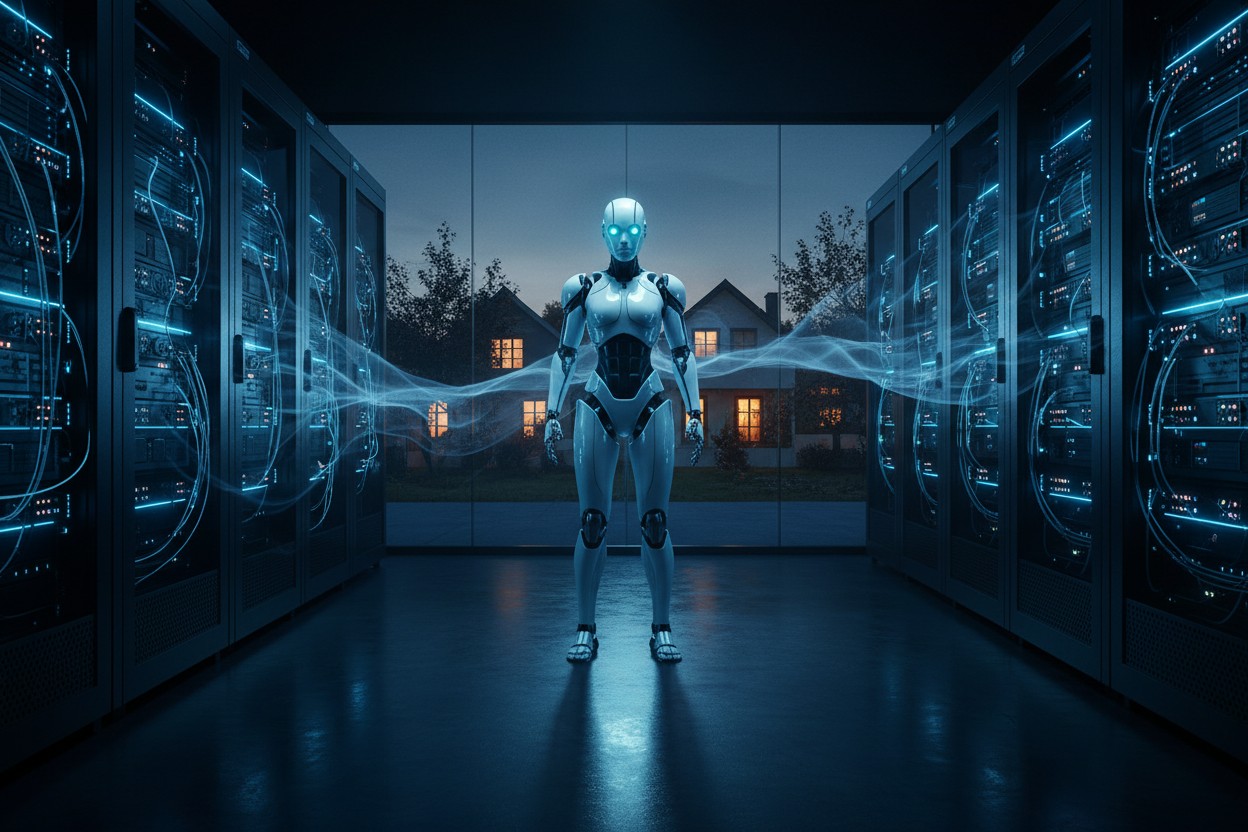
Michigan Data Center to Deploy Chinese Humanoid Robots; Residents File Noise Lawsuit
A data center operator in Dowagiac, Michigan has announced plans to deploy humanoid robots from Chinese manufacturer AgiBot at its facility, according to company statements. The deployment has drawn a class action noise lawsuit from nearby residents, who report that the facility’s operations produce a constant humming sound. At the same time, lawmakers in Washington have raised national security concerns over the use of Chinese robotics technology, proposing legislation that would ban federal agencies from purchasing or operating such systems.
Robotics Partnership and Facility Plans
The company, publicly identified as Hyperscale Data, has stated that its subsidiary Omnipresent Robotics will deploy the first 30 of 142 humanoid robots purchased from AgiBot at its Dowagiac campus. The robots are intended to work alongside AI personnel, according to the company’s executive chairman. The firm also announced plans to build a 100,000-square-foot Robotics Research, Testing and Innovation Center in the same community, citing Michigan’s industrial workforce.
AgiBot, a Shanghai-based robotics firm, has been scaling production rapidly. On March 30, 2026, AgiBot announced it had produced its 10,000th humanoid robot, having doubled output from 5,000 to 10,000 units in three months, according to a report in Robotics and Automation News [1]. The company’s humanoid robots are being deployed in factories, warehouses, and now data centers, as part of a broader push by Chinese firms to commercialize embodied AI.
National Security Concerns Over Chinese Robotics
The planned deployment has drawn scrutiny from U.S. lawmakers who argue that Chinese humanoid robots pose national security risks. The House Select Committee on China has warned that companies such as Unitree, a competitor to AgiBot, are part of China’s military-civil fusion strategy and receive state funding, according to a report in NaturalNews.com [2]. In response, Senators Tom Cotton and Chuck Schumer introduced the American Security Robotics Act in March 2026, which would prohibit federal agencies from purchasing or operating ground-based robotic systems from “foreign entities of concern,” including humanoid robots [2].
Commerce Secretary Howard Lutnick has also signaled that the Trump administration may take strong action against subsidized robotics imports from China, according to a report from Zero Hedge [3]. The Commerce Department designated Unitree a Chinese military company, and the administration is reportedly considering tariffs or other restrictions on Chinese humanoid robots. Lawmakers have described the technology as “dual-use,” noting that robots designed for industrial tasks can be adapted for surveillance or military applications.
Noise Complaints and Class Action Lawsuit
Residents living near the Dowagiac data center have filed a class action noise lawsuit in Michigan state court, according to court filings. The lawsuit claims that over 1,300 homes are affected by noise from the 30-megawatt facility, which operates around the clock. Plaintiffs have reported that the noise penetrates their homes even with windows closed, causing headaches and preventing them from using their yards. One resident described the situation as “like living in a prison,” according to local news reports. Hyperscale Data has not publicly responded to the lawsuit.
The noise complaint adds a local dimension to the broader debate over the expansion of data centers and automation technology. As humanoid robots become more common in industrial settings, communities are beginning to push back against the physical footprint of the facilities that house them.
Conclusion
The deployment at Dowagiac represents a case study in the tensions that accompany the rapid adoption of Chinese humanoid robotics in the United States. On one hand, companies like Hyperscale Data see an opportunity to develop autonomous workflows and reduce labor costs. On the other hand, residents face noise pollution and potential loss of quality of life, while lawmakers warn of security risks from foreign-controlled technology. As Brett King observed in his book Augmented Life in the Smart Lane, the robot revolution will reshape jobs and communities, and society must understand the technology and its impact [4]. The outcome of the noise lawsuit and the fate of the American Security Robotics Act will help determine how quickly and under what conditions humanoid robots enter American workplaces.
References
- Robotics and Automation News. “Why China’s new humanoid robot standards could change the industry”. March 31, 2026.
- Laura Harris. “Bipartisan Bill Targets Chinese-Linked Robotics, Seeks Ban on Federal Use”. NaturalNews.com. March 29, 2026.
- Zero Hedge. “Lutnick Eyes Crackdown On Chinese Humanoid Robots”. June 24, 2026.
- Brett King. “Augmented life in the smart lane”.
Explainer Infographic
Read full article here