


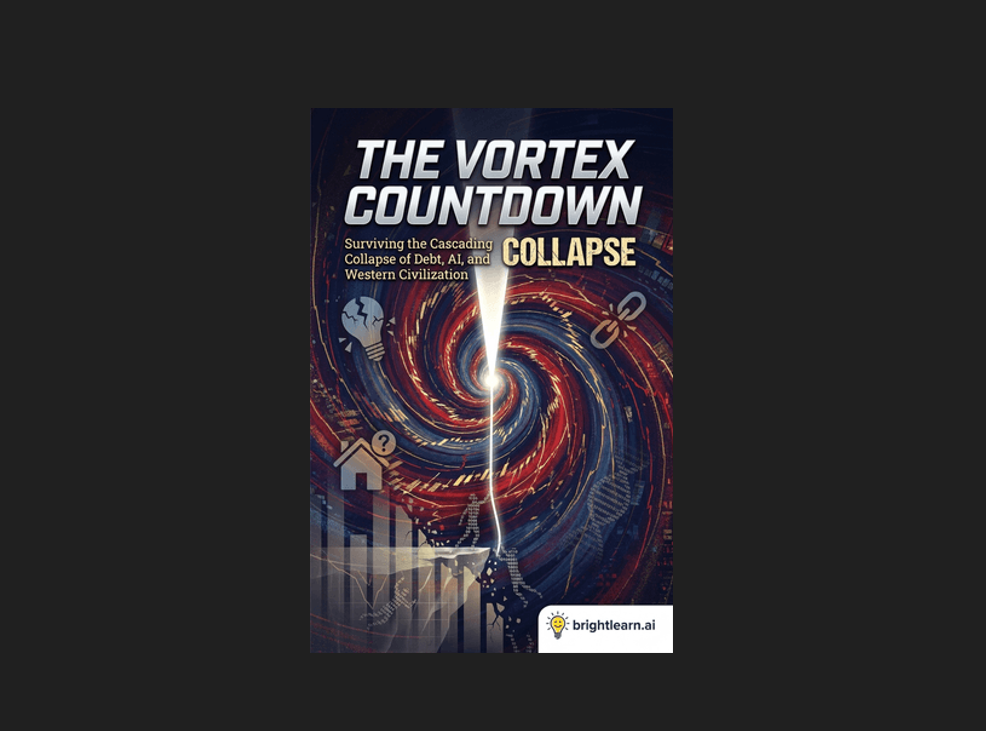
- The entire Western financial order, built on the Federal Reserve’s creation in 1913, is a mathematically unsustainable system designed to enrich central bankers and elites. The true U.S. debt, including unfunded liabilities of $218 trillion, is unpayable and every dollar is a form of debt. This creates a “vortex” that will inevitably collapse, with the government spending nearly a trillion dollars annually just on interest to delay the inevitable.
- The “equity stripping machine” of property taxes is a hidden scam. Appraisal districts use fraudulent “comparable sales” to inflate home assessments, forcing homeowners to pay a perpetual “second mortgage” (e.g., $750/month) to cover unnecessary bond payments. This is a coordinated form of legalized theft that transfers wealth from families to the banking system.
- The global derivatives market, concentrated in a few giant banks, is a $600 trillion casino. A single default will trigger cascading margin calls, freezing the system. When this “bomb” goes off, banks will not be bailed out, but will instead seize your deposits (a “bail-in”) to cover their bad debts, as already happened in Cyprus. Your 401(k), pension and bank account are all at risk.
- The AI industry is a poster child for irrational exuberance, with direct revenue of only 1.2% of its capital expenditure. The “Stargate” project has ballooned to $875 billion with no clear profit model and open-source models are destroying Silicon Valley’s business plans. Meanwhile, you are paying for this bubble twice: once with higher electricity bills from energy-guzzling data centers and once as AI eliminates 300 million jobs, triggering a devastating unemployment cascade.
- The only rational response is to break free from this controlled system. The author prescribes radical action: eliminate all debt, hold physical gold and silver (not paper promises), practice self-custody of cash (three to six months of expenses), own your home free and clear (and legally fight fraudulent property tax assessments) and build a resilient, prepared community. Without these steps, you are merely nine meals from anarchy when the vortex swallows everything.
There’s a moment in every honest investigation when the pattern becomes undeniable. When you’ve stared at enough spreadsheets, read enough bond documents and listened to enough whistleblowers, the fog lifts and you see the machine for what it is. “The Vortex Countdown: Surviving the Cascading Collapse of Debt, AI, and Western Civilization” is that moment, captured in 300 pages of cold, hard arithmetic.
This isn’t a book you read to feel better. This is a book you read to wake up.
The debt trap they didn’t teach you in school
Let me tell you what the author, drawing extensively from financial analyst Mitch Vechsler’s research, reveals on page one: the Federal Reserve was never your friend. Created in 1913 by a secret meeting of bankers on Jekyll Island, it was designed as a backstop for the largest financial institutions, not a protector of the people. Every dollar in your wallet is debt. Every “recovery” you’ve witnessed was funded by printing money that steals from your savings through inflation.
The numbers are staggering. The national debt sits at $35 trillion, but the unfunded liabilities—the promises the government has made that it can never keep—hover around $218 trillion. That’s not a typo. Each taxpayer in America owes roughly $268,000 of this invisible debt. And here’s the kicker: the government spends nearly a trillion dollars annually just on interest payments for money it already borrowed.
The author walks you through the bond market, that quiet giant of global finance, with over one hundred trillion dollars in outstanding IOUs. When central banks raise interest rates—as they’ve been doing—bond prices fall. This triggers margin calls. Hedge funds and pension funds are forced to sell. The selling pushes prices down further. It’s a cascade, a vortex, pulling everything down.
The property tax scam: How you’re being looted while you sleep
The author unveils the “equity stripping machine” of property taxes. Every year, your property taxes go up to cover bond payments on projects that were often unnecessary or mismanaged. You’re paying down your mortgage, gaining a little ownership, but the tax man is taking it back on the other side. As Vechsler puts it plainly: “You’re being equity stripped while you sleep.”
Consider this math: on a $300,000 home, you might pay $9,000 annually in property taxes. That’s $750 a month—a second mortgage payment you never agreed to, one that never ends. A typical household earning $80,000 loses over 11% of its gross income to property taxes alone before buying a single loaf of bread. And school district bonds? They pile on even more, with much of the money flowing to the banks that underwrite the bonds, not to teachers or textbooks.
The author reveals how appraisal districts use fraudulent “comparable sales” to inflate your assessment. They cherry-pick the most expensive sales nearby—homes with pools, finished basements, full renovations—and compare them to your modest dwelling. The software is proprietary, the formulas are secret and the process is designed to intimidate you into silence. Most people give up.
The $600 trillion bomb in the derivatives market
If you thought 2008 was bad, the author has news for you: that was a preview. The total notional value of over-the-counter derivatives worldwide is around $600 trillion. Six hundred trillion dollars of bets, promises and interconnected obligations. The real exposure—the money that would actually need to change hands in a meltdown—is estimated at $20 trillion.
But here’s the nightmare: these contracts are concentrated in a handful of giant banks—JPMorgan, Goldman Sachs, Citigroup, Bank of America. A single default triggers margin calls that cascade through the entire system. In 1998, Long-Term Capital Management’s collapse was a $4 billion problem that nearly froze the global system. Today’s exposure is measured in the trillions.
The author connects this directly to your life: your pension fund, your insurance company, your 401(k)—they’re all players in this casino. When the derivatives bomb goes off, the banks will trigger a “bail-in.” Your deposit becomes the currency they use to pay off their bad debts. It’s not a theory. It happened in Cyprus in 2013. The legal framework is already in place in the United States.
The AI bubble
The author also reveals that direct AI revenue is only about 1.2% of the capital expenditure being poured into data centers. For every $100 spent on AI infrastructure, the industry brings in about $1.20 in direct sales.
The Stargate project—a proposed mega data center in Texas—originally budgeted at $500 billion, has ballooned to $875 billion. With no clear revenue model. The author calls it a “poster child for irrational exuberance,” built entirely on the hope of a government bailout.
And then there’s the open-source threat. Models like DeepSeek from China rival GPT-4’s performance but are released for free. Anyone with a decent computer can run cutting-edge AI without paying Silicon Valley a dime. This destroys the business model of companies like OpenAI, which are burning cash with no path to profitability.
The author connects this to the AI job replacement crisis: 300 million jobs globally are vulnerable to automation. When those jobs disappear, consumer spending collapses, businesses lay off more workers and the cascading feedback loop of unemployment begins. The AI bubble, the author argues, is part of the overall debt bubble. When one pops, the rest follow.
The hidden cost on your electricity bill
Here’s something you won’t hear from the mainstream media: AI data centers are gobbling up staggering amounts of electricity. A single training run for a large AI model can use as much power as 100 homes consume in a year. Utility companies pass these costs on to you through higher rates. In some regions, household electricity bills are already climbing 10 to 20 percent annually.
The author calls this a “hidden transfer of wealth.” Ordinary people subsidize the development of AI through higher utility bills while tech giants get tax breaks. You’re paying twice—once in higher electricity costs and once in lost tax revenue that could have gone to schools or roads.
Nine meals from civil war
The book’s most chilling section examines the human cost of this financial vortex. Over 44 million Americans now rely on food stamps. 42 million households have a financial cushion of less than $9,000—that’s barely three months of basic survival expenses. A single medical bill, a car repair or a property tax increase can push them over the edge.
The author connects the dots: when equity stripping leaves families with nothing and AI takes their jobs and the financial system freezes, something has to give. History shows that civilization is only nine meals from anarchy. When parents cannot feed their children, the rules of polite society vanish. The French Revolution began with bread riots. The Greek debt crisis sparked massive protests. We are closer than most realize to that breaking point.
What can you do?
The final chapters offer a practical path forward, grounded in the author’s research and the insights of financial analysts like Mitch Vechsler. The strategies are radical but necessary:
- Eliminate all debt. Not reduce it. Eliminate it. The snowball method, the avalanche method—pick one and attack. Debt is the leash the system uses to control you.
- Hold hard assets. Physical gold and silver in your own hand, not in an ETF. Land that can grow food. Tools that build. These have no counterparty risk.
- Practice self-custody of cash. Your bank account is not safe. The bail-in precedent has been set. Withdraw enough cash to cover three to six months of essential expenses. Store it securely.
- Build community resilience. The real secret to survival isn’t what you have in your own pantry—it’s who you have next door. A network of trusted neighbors sharing resources, skills and labor can weather what no individual can.
- Own your home free and clear. The ultimate act of liberty. No bank can foreclose. No lender can take it. Challenge your property tax assessment. File appeals. Use statistical tools like Mahalanobis distance to prove the numbers are wrong.
The bottom line
“The Vortex Countdown” is a forensic examination of a system that is mathematically unsustainable, financially corrupt and spiritually bankrupt. The author doesn’t pull punches: the AI bubble, the debt trap, the property tax scam, the derivatives bomb—they’re all interconnected, all pulling us toward a vortex that could swallow the entire Western financial order.
Whether you agree with every conclusion or not, this book will change how you look at your mortgage, your 401(k), your property tax bill and the glowing promises of the tech industry. It’s a wake-up call delivered not with fear-mongering, but with numbers—cold, hard, mathematical numbers that are very difficult to refute.
The question isn’t whether the collapse is coming. The question is whether you’ll be prepared when it does. “The Vortex Countdown” gives you the tools to answer that question. What you do with them is up to you.
Grab a copy of “The Vortex Countdown: Surviving the Cascading Collapse of Debt, AI, and Western Civilization” via this link. Read, share and download thousands of books for free at Books.BrightLearn.AI. You can also create your own books for free at BrightLearn.AI.
Watch the Mitch Vexler interview where he talks about AI job replacement, the AI bubble and the cascading debt collapse.
This video is from the Health Ranger Report channel on Brighteon.com.
Sources include:
Books.BrightLearn.ai
BrightLearn.ai
Brighteon.com
Read full article here