


Key Takeaways
- A homeowners association in Port St. Lucie attempted to ban firearms in common areas, but faced pushback from the Florida Attorney General and local police.
- The HOA’s rule, passed in December 2025, broadly restricted firearms on its property, affecting many areas and people.
- The Attorney General’s letter pointed out the rule violates Florida law, specifically Section 790.251 regarding the right to bear arms.
- The Port St. Lucie Police Department clarified that HOA rules are not enforceable as laws or ordinances, emphasizing support for residents’ rights.
- This situation illustrates that HOA rules, while written, may not be lawful or enforceable against state statutes.
Estimated reading time: 5 minutes
PORT ST. LUCIE, FL — A homeowners association tried to ban firearms across its common areas. Within days, both the Florida Attorney General and the local police chief made clear the HOA had badly overstepped.
Here is what happened. The Tradition Community Association in Port St. Lucie adopted a rule its board passed by unanimous written consent on December 5, 2025. The rule states that “no person shall carry or possess any firearm or other weapon, whether open or concealed, on any Common Area owned or maintained by the Association.” On May 11, 2026, the association mailed residents a letter spelling it out, noting the ban “applies even if you do have a ‘concealed carry’ license for your weapon.”
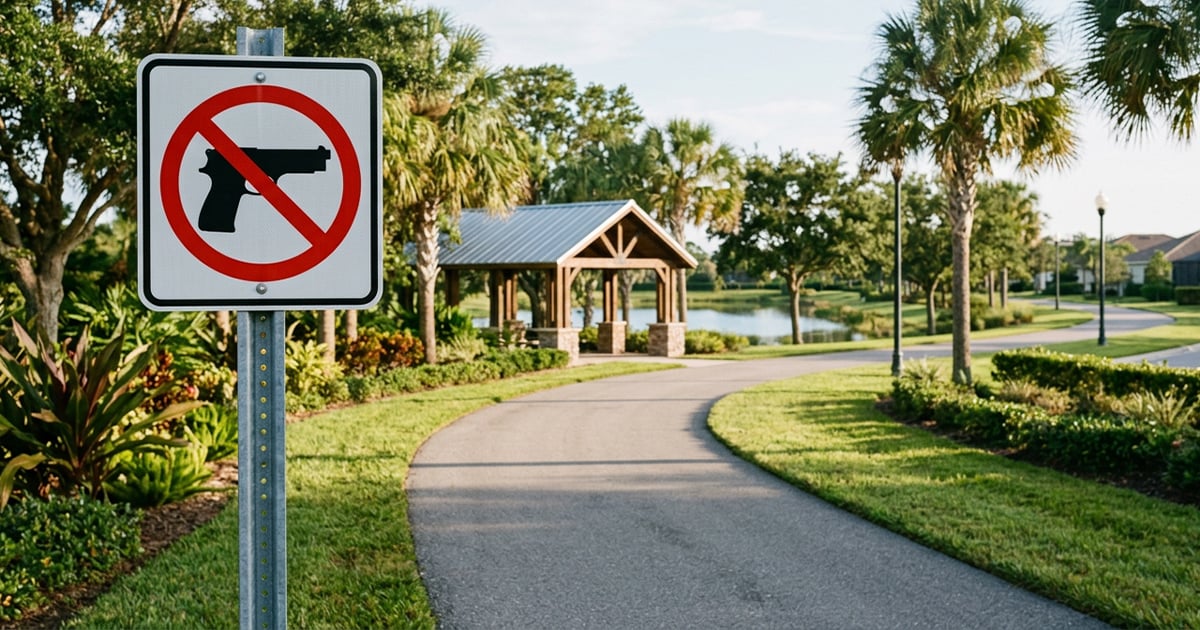
The reach was broad. By its own terms the rule covered the Town Hall, Town Square, gazebo, splash pad, tot lot, dog park, parks, trails, stormwater areas, and other common areas. It applied to owners, tenants, guests, invitees, and contractors alike. The rule did carve out a few exceptions, including lawful carry while passing through internal streets and sidewalks, firearms inside private vehicles, and law enforcement.
Then the state stepped in. On May 21, 2026, Florida Attorney General James Uthmeier sent the association’s president a letter telling him the rule violates Florida law. He pointed to Section 790.251 of the Florida Statutes, which bars a private employer from expelling a customer or invitee for exercising the right to keep and bear arms.
The AG’s reasoning is worth understanding, because it is more specific than a general appeal to the Second Amendment. The association is a not-for-profit corporation with employees, including a general manager, property manager, and maintenance staff. Under the statute, that makes it a private employer. Its employees who are licensed to carry cannot be fired or punished for exercising that right, and anyone visiting the common areas counts as an invitee who cannot be expelled for it either. He also cited longstanding Florida case law that an HOA cannot adopt arbitrary rules unrelated to residents’ health, happiness, and enjoyment.
More from USA Carry:
Uthmeier gave the association until June 1, 2026, to certify in writing that it will not enforce the rule. If it refuses, he wrote, his office will take action to enforce the law, citing the state’s authority to go after a corporation acting beyond its powers. He closed the letter bluntly: “This is not New York or California. In Florida, the right of the people to keep and bear arms ‘shall not be infringed.’”
The local police were just as direct. The Port St. Lucie Police Department issued a statement from Chief Leo Niemczyk clarifying that the HOA letter “is not a law, ordinance, or official directive” from the department or the city. PSLPD said it enforces Florida state law, not private HOA policies, and that while associations may set certain policies for their properties, those policies “do not constitute criminal violations and will not be enforced by PSLPD.” The chief added that the department fully supports the constitutional rights of residents, including those protected under the Second Amendment.
I think this is an important case to watch, and not just because the gun owners came out ahead. It is a clean illustration of something a lot of people get wrong. A private association can write almost anything into a rule, but writing it down does not make it lawful or enforceable. Florida has specific statutory protections that an HOA board cannot simply vote around, and a community association is not a government with the power to create gun-free zones across an entire neighborhood.
It also shows the limit of these paper policies. Even setting the statute aside, the police made clear they were never going to treat a violation of the HOA rule as a crime. The worst the association could realistically do is pursue its own internal civil measures, and the AG’s letter calls even that into question.
If you live under an HOA and get a notice like this, the move is not to panic and it is not to assume the rule binds you the way a law would. It is to know your state’s actual statutes. In Florida, residents had strong protection on their side, and it took the Attorney General about ten days to say so in writing.
The association has until June 1 to respond. I will keep tracking how this one resolves, and whether the state follows through if the HOA digs in.
Read full article here