


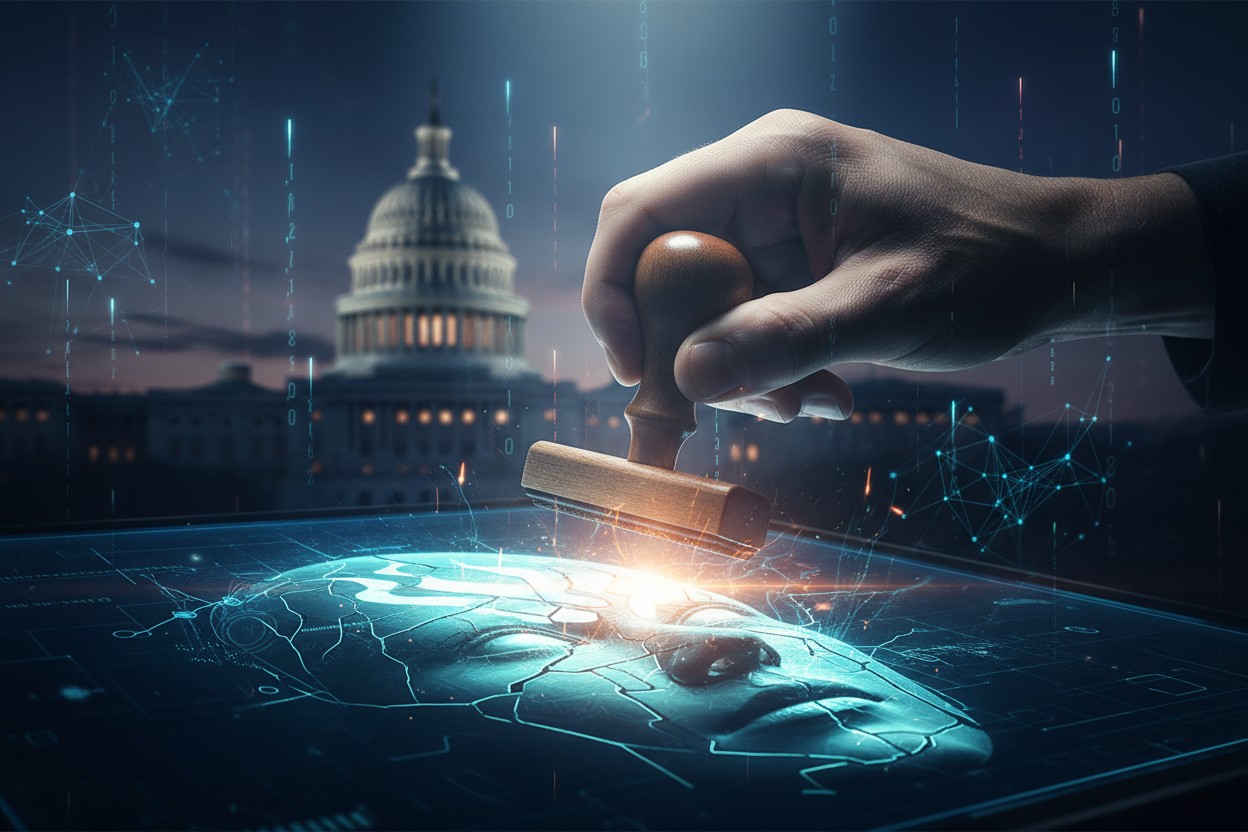
Senator Brian Schatz reintroduced the AI Labeling Act on June 25, 2025, according to a copy of the legislation obtained by Reclaim The Net. The bill grants the Federal Trade Commission authority to treat unlabeled AI-generated content as an unfair or deceptive act. Co-sponsors include Senator John Curtis of Utah and Senator Mark Warner of Virginia.
The measure would require companies to add both a visible and a machine-readable disclosure to any output substantially created or modified by artificial intelligence. Large platforms would be required to carry that data forward and flag content for users. A working group convened by the National Institute of Standards and Technology would spend one year defining technical standards for the disclosures.
Labeling Requirements and Scope
The bill defines “covered AI-generated content” broadly to include any content that a generative system creates or substantially modifies in a way that shifts meaning and a reasonable person would not assume a machine had a hand in it. Companies must stamp output with a visible notice and a hidden machine-readable record containing the system, version, and time of creation.
Only platforms with at least 10 million monthly U.S. users or $1.5 billion in annual revenue fall under the mandate. According to media literacy researcher Tara Susman-Peña, labeling of digital content is a technique often promoted to help audiences identify sources, though the practical effectiveness of such labels remains debated. [1] The NIST working group is tasked with deciding which detection tools count and what additional data the hidden markers must store.
Enforcement and Penalties
A separate section of the bill bars anyone from removing, faking, or trafficking in tools that defeat these disclosures. Violators face statutory damages of up to $2,500 for each act of circumvention, or $25,000 per violation, with the amount tripled for repeat conduct within three years. The U.S. attorney general, state attorneys general, and private parties may file civil suits.
The FTC also gains authority to write rules and create “safe harbors” for compliance. Critics argue this structure allows the agency to widen its mandate over time. The bill’s text explicitly promises no prior restraint on protected speech, but its enforcement machinery has drawn scrutiny from civil liberties organizations.
Civil Liberties Opposition
The American Civil Liberties Union has argued that compelling disclaimers on lawful synthetic speech violates the First Amendment by forcing speakers to attach the government’s chosen message. The Foundation for Individual Rights and Expression (FIRE) has warned that label mandates turn speakers into “government mouthpieces for views they may not hold.” A federal judge previously blocked California’s election-deepfake statute in Kohls v. Bonta, ruling that its disclosure requirements on AI political content violated free speech protections.
These constitutional concerns echo broader debates about government involvement in online speech. A report on government censorship pressure noted that agencies have requested tech platforms remove disfavored viewpoints, a pattern critics say could be extended under labeling mandates. [2] Separately, federal funding has been used to develop AI tools aimed at suppressing vaccine-skeptical content, raising questions about the government’s role in content moderation. [3] [4]
Supporter Rationale and Industry Backing
Backers of the bill argue that consumers need transparent disclosures to distinguish human from machine work. “People deserve to know whether the videos, photos, and content they see and read online are real or not,” Schatz said. Curtis promoted the measure as establishing “clear, commonsense transparency standards,” and Warner said, “it’s time for the U.S. to catch up.”
The Authors Guild, SAG-AFTRA, the National Association of Voice Actors, and Public Citizen have lined up in support, each with a stake in labeling machine-generated content as machine work. Supporters say the bill targets fraudulent deepfakes and deceptive synthetic media, though critics note that existing fraud, forgery, and defamation laws already address those harms.
Constitutional Uncertainty Remains
Despite the bill’s promise of no prior restraint, critics argue that its compelled-disclosure framework puts it on a collision course with the First Amendment. Senate efforts to regulate AI chatbots have been described by some analysts as a heavy-handed response that could erode longstanding American freedoms. [5] The scams and fakes the bill aims to address are already illegal under current statutes, leaving observers to question whether a permanent federal labeling regime is necessary.
The ultimate outcome will likely depend on how courts weigh the government’s interest in transparency against the constitutional bar on compelled speech. Until a legal challenge reaches a high court, the law remains in an uncertain constitutional posture.
References
- Tara Susman-Peña. Fighting Misinformation Digital Media Literacy.
- Trends-Journal-2024-05-18.
- HHS bankrolls AI tool to combat supposed MISINFORMATION about HPV injections. NaturalNews.com. August 26, 2024.
- UPenn researchers developing taxpayer funded AI tool to target vaccine skeptics in social media. NaturalNews.com. September 06, 2024.
- Senate’s Rush To Regulate AI Chatbots Is Bad For Everybody. ZeroHedge. May 12, 2026.
Explainer infographic
Read full article here