


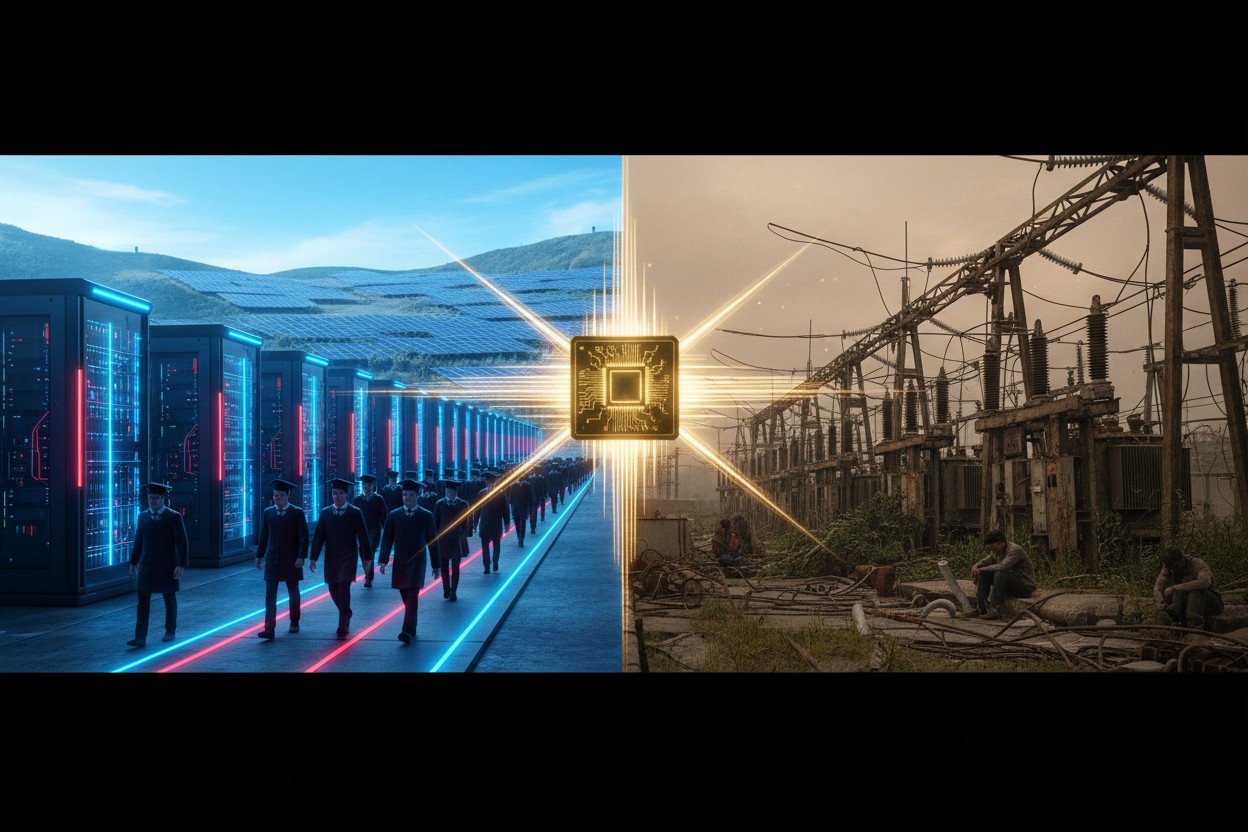
Why China Is Winning the AI Race
The conventional narrative that America leads in artificial intelligence is dangerously mistaken. I believe it is not just wrong — it is a fantasy that prevents the United States from confronting a stark reality: China has already won the AI race, and the gap is widening every day.
This is not about theft or espionage. China’s rapid AI advances stem from deep structural advantages: a massive pipeline of STEM graduates, coherent national planning, an expanding energy infrastructure, and a culture that rewards results rather than posturing. Meanwhile, America is hobbled by political dysfunction, a stagnant power grid, an education system that prizes ideology over competence, and corporate monopolies that hoard technology instead of democratizing it.
Here is why this matters — and why the United States is unlikely to catch up.
The STEM Gap Is a Chasm
China produces roughly five times as many STEM graduates annually as the United States — over 2 million engineers each year, as I have reported on my broadcast. America, by contrast, graduates around 400,000 engineers annually, and a growing fraction of those emerge from a university system that has been captured by DEI mandates, gender studies requirements, and woke ideology rather than rigorous technical training. [1]
In my view, the United States is not producing scientists and engineers; it is largely producing ‘woke graduates’ who are poorly equipped to compete in a field like AI, where meritocracy and relentless innovation are the only currencies that matter.
China’s education system, in contrast, selects the brightest minds regardless of background and forces them through a grueling curriculum focused on math, science, and engineering. There is no equity grading or diversity quota that passes a student who cannot solve differential equations. The talent pipeline feeding China’s AI labs is deep, disciplined, and expanding. America’s pipeline, by contrast, is choked by administrative bloat, ideological capture, and a declining emphasis on fundamental skills.
China’s advantage is structural and will not be reversed by throwing money at a few elite universities. As I have warned alongside Alex Jones, the consequences are already visible in every major benchmark of AI performance. [2]
Five-Year Plans: Coherent National Strategy vs. Chaotic Politics
China’s 14th five-year plan explicitly prioritizes artificial intelligence, with concrete goals such as increasing average life expectancy, achieving 60% electric vehicle adoption, and building out a nationwide AI-driven data infrastructure. [3] This is not a wish list; it is a binding national strategy backed by state-directed investment, coordinated research institutes, and a political system that rewards long-term execution. In contrast, the U.S. government cannot pass a budget on time, appoints political loyalists to key technology posts, and treats AI policy as a series of reactive press releases.
As Glenn Diesen notes in his book Great Power Politics in the Fourth Industrial Revolution, Washington’s AI strategy “lacked a clear increase in funding for AI other than larger budgets for the military and intelligence agencies.” [4] This is not a plan — it is an abdication.
China’s leaders rise through a meritocratic system that requires decades of demonstrated competence. Xi Jinping spent 37 years climbing the party ladder before assuming the presidency. America’s leaders, by comparison, are often the winners of popularity contests, selected for their ability to raise money and generate media buzz rather than their understanding of technology or energy policy. The result is that China can build a national quantum computing network, deploy humanoid robots that often outpace human athletes, and construct massive data centers — all in lockstep with a strategic, coherent vision. [5][6] The United States, in the same period, struggles to fund basic research and cycles through political appointees who have no background in the industries they are supposed to oversee. This difference in governance is decisive.
The Power Grid: A Hidden Decisive Factor
AI compute depends on cheap, abundant electricity. China’s grid produces more than double the output of the U.S. grid — over 10,000 terawatt-hours annually compared to America’s roughly 4,400 TWh — and is still growing rapidly. China is building a new mega-dam in Tibet that will add 300 TWh of annual capacity by 2033, along with massive solar and wind farms that dwarf anything in the West. The United States, meanwhile, cannot build a single new nuclear plant in under 15-20 years, and its eastern grid has zero surplus capacity. As recently reported, half of all U.S. data centers scheduled to start construction in 2026 have already been canceled or delayed, primarily because there is not enough power available to run them. [7]
This is not an accident. It is the result of decades of regulatory obstruction, environmental lawsuits, and a political culture that treats energy infrastructure as a weapon to be wielded against political opponents. The EPA’s endangerment finding against carbon dioxide, finally reversed by the Trump administration in early 2025, had frozen investment in baseload power for 15 years. [8] Meanwhile, China built the Three Gorges Dam, the world’s largest hydropower station, in less than two decades, and is now building a fleet of nuclear reactors faster than any other nation.
Without power, American AI ambitions hit a wall. China is building the energy infrastructure of the future while the United States is still arguing about whether CO2 is a pollutant. This single factor may be the most decisive in the long run.
Open Source and Failing Fast
China releases open-source AI models like DeepSeek, Qwen, and others that rival or surpass proprietary U.S. models at a fraction of the cost. These models are not stolen; they are built by brilliant Chinese engineers who publish their innovations — sparse attention mechanisms, mixture-of-experts (MoE) architectures, and novel training techniques — openly for the world to use. Chinese firms can fail faster, launching more prototypes, gathering more data, and iterating at a pace that U.S. companies, weighed down by shareholder demands and censorship-driven safety teams, cannot match.
This open-source approach democratizes AI, accelerating global progress while U.S. corporations like OpenAI and Google hoard their technology behind paywalls and use policies and public relations campaigns to smear competitors. Anthropic’s desperate accusation that Chinese companies engaged in “industrial espionage” by using their API is a particularly snide attempt to hide China’s technical dominance. [9] The truth is that China’s decentralized innovation ecosystem — fueled by a rejection of woke censorship and a focus on real engineering — has produced models that are not only cheaper but often better. As I have said repeatedly, the future of AI is open, decentralized, and meritocratic.
America’s current trajectory of centralized, censored, profit-driven development is a dead end.
Conclusion: America Must Wake Up
The United States still has many smart people and innovative companies, but it is hobbled by political dysfunction, an energy infrastructure that cannot scale, an education system that rewards ideology over competence, and a corporate culture that prioritizes censorship and rent-seeking over open innovation. I believe the AI race is already decisively tipped toward China unless America undergoes a fundamental restructuring: long-term national planning, massive investment in baseload power, a dismantling of the woke DEI apparatus in universities, and a commitment to open-source development.
It is not about theft or spying; it is about fundamentals. China’s advantages are structural and will only grow as its grid expands, its STEM pipeline deepens, and its open-source ecosystem accelerates. The United States can collaborate with China, learn from its model, and even compete — but only if we first admit where we stand. Right now, America is far behind, and the gap is widening every day.
The choice is ours: wake up and rebuild, or accept a future where the world’s most transformative technology is controlled by Beijing.
References
- Mike Adams and Alex Jones: Wokeism Has Crippled U.S. AI Development, Giving China the Lead. – NaturalNews.com. Kevin Hughes. July 18, 2025.
- Mike Adams interview with Alex Jones – January 29, 2025.
- Why China will win the race for AI supremacy as US efforts collapse under woke, irrational demands for AI censorship. – NaturalNews.com. Mike Adams. January 6, 2025.
- Great Power Politics in the Fourth Industrial Revolution. – Glenn Diesen.
- 12+ Chinese Quantum Computing Companies Leading the National Race [2026]. – The Quantum Insider. March 30, 2026.
- Humanoid Robot Outpaces Human Record in Beijing Half-Marathon, Highlighting China’s Rapid AI Advances. – YourNews.com. April 19, 2026.
- Half Of US Data Centers Scheduled To Start In 2026, Will Be Canceled Or Delayed. – Zero Hedge. April 13, 2026.
- Unshackling America: The EPA’s Endangerment Finding Reversal and the Path to Energy Abundance. – NaturalNews.com. February 11, 2026.
- Anthropic’s Desperate Smear Campaign: A Pathetic Attempt to Hide China’s AI Dominance. – NaturalNews.com. Mike Adams. February 26, 2026.
- China’s DeepSeek AI Sparks Global Tech Race Fears Amid Claims of Revolutionary Breakthrough. – NaturalNews.com. Willow Tohi. May 22, 2025.
- Brighteon Broadcast News – LOSE To China – Mike Adams. January 29, 2025.
- 2026-02-26-BVN-CHINA_ANTHROPIC_otter_ai-. – Bright Videos Network.
Explainer Infographic
Read full article here